

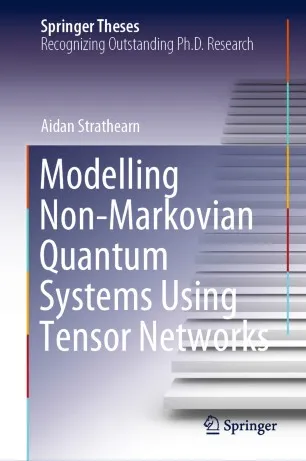
Book guide and evaluation
Modelling Non-Markovian Quantum Systems Using Tensor Networks
Aidan Strathearn
English
Beginner
Physics
4.3 / 5
0 reviews
2020
Published
113
pages
209
views
Introduction to "Modelling Non-Markovian Quantum Systems Using Tensor Networks" "Modelling Non-Markovian Quantum Systems Using Tensor Networks" is a groundbreaking book that synthesizes quantum physics, tensor network theory, and computational methodologies into
Before you read
What will you get from this book?
Introduction to "Modelling Non-Markovian Quantum Systems Using Tensor Networks"
"Modelling Non-Markovian Quantum Systems Using Tensor Networks" is a groundbreaking book that synthesizes quantum physics, tensor network theory, and computational methodologies into a coherent and accessible framework. This book offers researchers, students, and professionals an in-depth guide to understanding and simulating the dynamics of non-Markovian quantum systems—those that display memory effects and sophisticated behaviors not easily captured by traditional approaches.
The aim of this book is to address one of the central challenges in quantum science: how to efficiently model complex quantum processes that are influenced by their histories. Utilizing tensor networks, a modern and rapidly developing computational tool, the book demonstrates how to overcome these challenges to unlock new possibilities in areas such as quantum materials, quantum technologies, and quantum thermodynamics. With a focus on non-Markovian systems, which often appear in condensed matter physics, quantum chemistry, and open quantum systems, this book bridges the gap between theory and practical implementation.
Detailed Summary of the Book
The book embarks on an introductory overview of quantum open systems and explores why the Markovian approximation—the assumption of no memory effects—often falls short in describing real-world quantum processes. It then introduces the theoretical underpinnings of tensor networks, emphasizing their role as a compact and versatile representation of quantum states and operators.
Subsequent chapters dive into the details of merging tensor networks with existing techniques, such as the time-evolving matrix product operator (TEMPO) approach and other state-of-the-art algorithms. Each technique is explained step-by-step, with a focus on clarity and practical implementation. The reader is guided through numerical examples, pseudo-code, and discussions on computational efficiencies, making the book a valuable resource for both theorists and computational physicists.
Towards the latter stages, the book expands its scope to include applications in quantum thermalization, exciton dynamics in organic materials, and the simulation of quantum technologies such as qubits coupled to non-Markovian environments. Emphasis is placed on how recent advances in tensor networks have revolutionized these fields, offering unprecedented accuracy and insights.
Key Takeaways
- A comprehensive understanding of non-Markovian dynamics and why they are critical for modeling real-world quantum systems.
- An introduction to tensor networks and how they simplify the complex mathematical frameworks of quantum many-body systems.
- Step-by-step guides for implementing tensor network techniques tailored to quantum environments with memory effects.
- Applications of these methodologies in cutting-edge research fields such as quantum computing, materials science, and chemistry.
- Insights from recent experimental and theoretical breakthroughs, contextualized in the framework of non-Markovian quantum systems.
Famous Quotes from the Book
"Understanding non-Markovianity in quantum systems is akin to tracing the intricate footprints of history within the fabric of time itself."
"Tensor networks offer us a way to see the forest rather than getting lost in the complexities of the individual trees."
"The beauty of non-Markovian quantum systems lies in their defiance of simplicity; they remind us that nature itself remembers."
Why This Book Matters
This book is indispensable for anyone working at the cutting edge of quantum research. The importance of non-Markovian quantum systems cannot be overstated; they are encountered in diverse areas, from quantum biology to quantum information science. Previously, accurately modeling these systems has been computationally prohibitive, but this book provides powerful tools and insights using tensor networks to break through such limitations.
In addition to providing practical methodologies, this book fosters a deeper conceptual understanding of how quantum systems interact with their environments and how memory effects fundamentally alter quantum processes. The text bridges specialized topics, ensuring that readers from physics, chemistry, and computational fields can uniformly gain from it. It serves as a unifying guide and is poised to become an essential reference for both students entering the field and seasoned researchers pushing its boundaries.
Ask this book
Your question is answered in the context of this title and author. Each answer uses 2 points.
Sign in to ask the book assistant.
Reader reviews
0 reviews, 4.3 average out of 5
No reviews yet
If you have read this book, help the next reader with your experience.
Write a review
Sign in to publish a review.
Reader questions and answers
Ask a focused question and learn from the community.
Sign in to ask or answer a question.
No questions yet
Be the first to ask a clear, useful question.
What to read next
Related references that continue this learning path.


Modern Computer Vision with PyTorch: A Practical Roadmap From Deep Learning Fundamentals to Advanced Applications and Generative AI, 2nd Edition
V Kishore Ayyadevara,Yeshwanth Reddy
2023
View book