The Age of Scientific Naturalism: Tyndall and His Contemporaries
Bernard Lightman,Michael S. Reidy
2014
View book
Book guide and evaluation
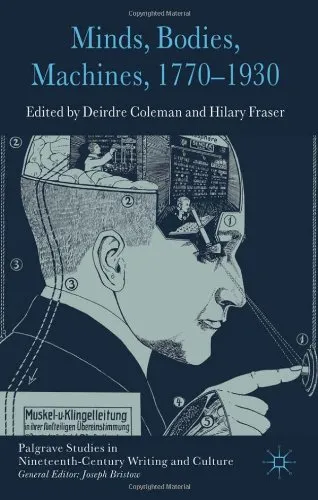
Deirdre Coleman,Hilary Fraser
0 reviews
Published
pages
views
Introduction Welcome to an exploration of the intricate relationships between minds, bodies, and machines during the transformative period from 1770 to 1930. In our book, "Minds, Bodies, Machines, 1770-1930", part of the Palgrave Studies in Nineteenth-Century Writi
Before you read
Welcome to an exploration of the intricate relationships between minds, bodies, and machines during the transformative period from 1770 to 1930. In our book, "Minds, Bodies, Machines, 1770-1930", part of the Palgrave Studies in Nineteenth-Century Writing and Culture, we navigate through this epoch to shed light on how technological advancements influenced modern thought, literature, and cultural practices. This time frame marks significant changes, where the rise of industrialization, scientific discoveries, and philosophical debates reshaped human identity and society's trajectory.
Our book delves into the dynamic interplay between human intellect, physical embodiment, and technological innovation. It examines the period marked by the Enlightenment's brainstorming, the mechanical age's dawn, and the cusp of modernism. Through a series of thought-provoking essays, the book discusses influential figures such as Mary Shelley, who challenged the boundaries of life and artificial creation, and Charles Babbage, whose pioneering work laid the groundwork for computing.
"Minds, Bodies, Machines" is divided into thematic sections that unravel the historical and cultural contexts of notable advancements. We scrutinize the era's literature and its role in reflecting and shaping contemporary understanding of humankind's place amidst burgeoning technology. The book also investigates the mutual influences between industrial technologies and literary forms, offering insights into how these changes impacted social identities and cultural expressions.
"With each advancement, humanity edged closer to its creations, blurring the lines between the organic and the mechanical."
"Literature did not merely imagine the future of machines—it sketched the possible futures of humanity intertwined with them."
"Minds, Bodies, Machines, 1770-1930" is crucial for understanding the profound impact of technological evolution on human thought and societal norms. Especially relevant in today's world, where artificial intelligence and digital technologies are rapidly evolving, this book offers historical context that enriches contemporary discussions. By analyzing the past, we can better comprehend the trajectory of current and future interactions between humanity and technology.
The book also provides a critical academic perspective for scholars, students, and enthusiasts of nineteenth-century literature and culture, drawing connections between historical technological advancements and present-day concerns. Its insights inform not only a historical understanding but also philosophical contemplation on what it means to be human in an age of machines—an inquiry as vital today as it was during the industrial revolution.
Your question is answered in the context of this title and author. Each answer uses 2 points.
0 reviews, 3.0 average out of 5
Sign in to publish a review.
Ask a focused question and learn from the community.
Related references that continue this learning path.
Bernard Lightman,Michael S. Reidy