

Book guide and evaluation
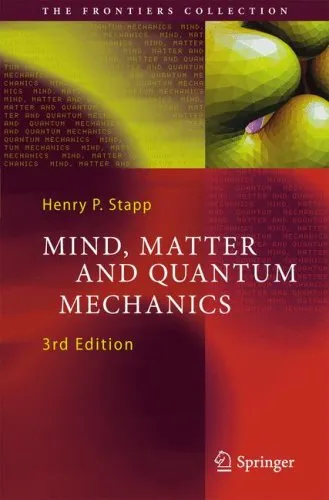
Mind, Matter and Quantum Mechanics
Henry P. Stapp (auth.),Henry P. Stapp (eds.)
English
Beginner
Art
4.5 / 5
0 reviews
2009
Published
303
pages
253
views
Introduction to "Mind, Matter, and Quantum Mechanics" "Mind, Matter, and Quantum Mechanics" is an insightful and profound exploration of the intricate relationship between consciousness, physical reality, and the revolutionary ideas brought forth by quantum mechanics. Written
Before you read
What will you get from this book?
Introduction to "Mind, Matter, and Quantum Mechanics"
"Mind, Matter, and Quantum Mechanics" is an insightful and profound exploration of the intricate relationship between consciousness, physical reality, and the revolutionary ideas brought forth by quantum mechanics. Written by physicist Henry P. Stapp, this book offers a thorough examination of how quantum theories intersect with questions about the nature of the mind and its role in shaping the material universe.
In a world where classical physics provided a deterministic framework for understanding physical phenomena, quantum mechanics shattered these conventions by introducing uncertainty and the idea of an observer-dependent reality. This book ventures into uncharted territories, connecting the findings of modern physics with philosophical, metaphysical, and psychological inquiries into the nature of existence. It’s a must-read for anyone interested in the interplay between science and human experience.
Detailed Summary of the Book
Henry P. Stapp delves into the historical progression of quantum mechanics, explaining how its principles deviate from the deterministic worldview of classical Newtonian mechanics. The book intricately describes how quantum physics implies that human consciousness plays an active role in shaping the physical reality we observe. Stapp critiques materialistic philosophies and proposes a more holistic perspective in which mind and matter are deeply interconnected.
By examining the philosophical implications of quantum theory, Stapp addresses profound questions such as:
- What is the role of the observer in defining physical reality?
- Does consciousness emerge from physical processes, or is it a fundamental component of the universe?
- How might quantum mechanics help us understand free will and moral responsibility?
The book also presents Stapp's interpretation of quantum mechanics, emphasizing the primacy of mind over matter. Through careful reasoning, he examines how quantum theories align with or challenge longstanding philosophical viewpoints about causality, existence, and the self.
Key Takeaways
- Quantum mechanics challenges the deterministic worldview of classical physics, introducing the concept that reality is probabilistic and influenced by observation.
- Mind and matter are not separate entities; they are intrinsically connected, with consciousness potentially playing a vital role in shaping our universe.
- The book argues against materialistic and reductionist theories, advocating for a more integrated understanding of how human consciousness fits within the framework of quantum mechanics.
- "Mind, Matter, and Quantum Mechanics" bridges the gap between scientific discoveries and age-old philosophical questions about free will, existence, and the nature of reality.
Famous Quotes from the Book
"In the quantum universe, there is no intrinsic separation between the observer and the observed. Reality is participatory."
"Mind is no longer a passive witness to the unfolding of events, but an active participant that shapes, influences, and determines what we experience as reality."
"Quantum mechanics has opened the door to a more profound understanding of the universe's most essential property: the interplay between mind, matter, and causation."
Why This Book Matters
Henry P. Stapp's "Mind, Matter, and Quantum Mechanics" is a vital work in the realms of both science and philosophy. It challenges readers to reconsider their fundamental assumptions about reality, causation, and consciousness in light of quantum mechanics. By addressing age-old questions through the lens of cutting-edge physics, it provides a fresh perspective on the universe and humanity's place within it.
The book is particularly significant because of its interdisciplinary approach, blending rigorous scientific analysis with philosophical inquiry. In a time when the boundaries between different fields of knowledge are becoming increasingly blurred, Stapp's work demonstrates how physics can inform—and even transform—our understanding of issues traditionally left to metaphysics and theology.
For anyone intrigued by the nature of reality, free will, or the connection between consciousness and the physical universe, this book offers an invaluable guide. It not only illuminates the quantum world but also provides thought-provoking insights into the human experience and our quest for meaning.
Ask this book
Your question is answered in the context of this title and author. Each answer uses 2 points.
Sign in to ask the book assistant.
Reader reviews
0 reviews, 4.5 average out of 5
No reviews yet
If you have read this book, help the next reader with your experience.
Write a review
Sign in to publish a review.
Reader questions and answers
Ask a focused question and learn from the community.
Sign in to ask or answer a question.
No questions yet
Be the first to ask a clear, useful question.
What to read next
Related references that continue this learning path.


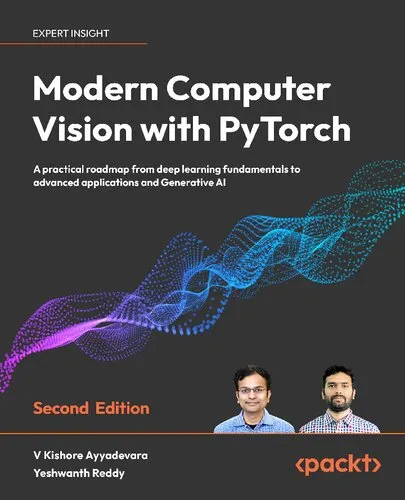
Modern Computer Vision with PyTorch: A Practical Roadmap From Deep Learning Fundamentals to Advanced Applications and Generative AI, 2nd Edition
V Kishore Ayyadevara,Yeshwanth Reddy
2023
View book