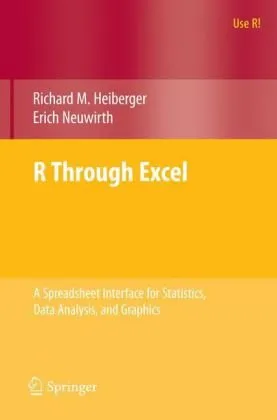
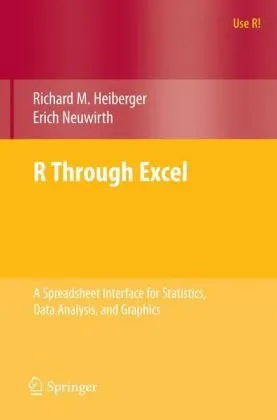
R Through Excel: A Spreadsheet Interface for Statistics, Data Analysis, and Graphics
Richard M. Heiberger,Erich Neuwirth (auth.)
2009
View book
Book guide and evaluation
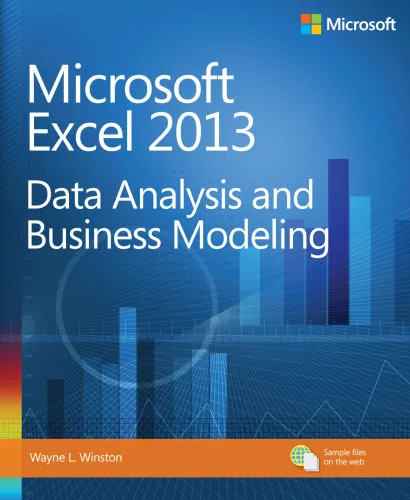
Wayne Winston
0 reviews
Published
pages
views
Microsoft Excel 2013 Data Analysis and Business Modeling Excel business analytics, advanced data modeling techniques Master Microsoft Excel 2013 Data Analysis and Business Modeling with proven methods for analytics and professional decision-making. Analytical Summary
Before you read
Microsoft Excel 2013 Data Analysis and Business Modeling is a meticulously structured guide for professionals, academics, and analysts seeking to harness the full potential of Microsoft Excel 2013 for complex decision-making, forecasting, and problem-solving. Authored by Dr. Wayne L. Winston, the book distills decades of teaching and consultancy experience into practical frameworks for tackling real-world business challenges through Excel’s powerful computational abilities.
The text bridges the gap between spreadsheet fundamentals and advanced analytics. Readers are guided through essential concepts such as regression analysis, optimization modeling, simulation techniques, and financial forecasting. By embedding case studies reflective of both corporate and academic scenarios, Winston ensures theoretical depth is matched by immediate applicability. This makes the book both a resource for day-to-day operations and a reference for long-term strategic projects.
With an emphasis on data integrity, reproducibility, and clear visualization, the author empowers users to move beyond basic chart creation into meaningful, data-driven narratives. Microsoft Excel 2013 functions as a versatile toolkit, and this volume teaches how to apply it in contexts like supply chain risk assessment, marketing ROI analysis, and performance benchmarking without overcomplicating processes.
Readers will gain both technical mastery and strategic insight applicable to a wide range of industries and research contexts.
First, the book provides step-by-step procedures for constructing and analyzing models that answer specific business questions. Second, it offers guidance on Excel functions and add-ins that enhance efficiency, enabling professionals to minimize errors and maximize clarity in decision-making.
Third, applied examples span various disciplines, emphasizing the adaptability of Excel business analytics. Fourth, the teaching style encourages critical thinking, so readers can tailor models to their organization’s unique needs. Finally, the integration of simulation tools allows for risk-aware planning and comparative scenario evaluation.
“The best way to learn Excel modeling is by solving problems you truly care about.” Unknown
“Data tells a story; models help you read it.” Unknown
“Excel is more than a spreadsheet—it's a decision-making engine.” Unknown
In an era defined by data-driven strategy, competence with robust tools like Microsoft Excel 2013 is not optional—it is essential.
Microsoft Excel 2013 Data Analysis and Business Modeling addresses a critical skills gap: the translation of raw data into actionable insights. While many professionals use spreadsheets daily, few are equipped to construct advanced analytical models that capture the complexity of modern business environments.
This book matters because it is more than a manual; it is a mentor. Its structured approach, reinforced with practical examples, enables readers to progress from novice data handlers to confident analysts capable of influencing high-stakes decisions. It underscores not only how to use Excel but why certain methods yield stronger, more reliable results.
Microsoft Excel 2013 Data Analysis and Business Modeling stands as a cornerstone for anyone serious about applying analytical rigor to professional and academic pursuits.
By weaving together theoretical precision with real-world practicality, the book becomes an indispensable resource for analysts, managers, researchers, and students alike. Whether you aim to refine existing workflows, implement new forecasting methods, or simply understand the logic behind model construction, this guide provides the foundation you need.
Now is the time to engage with its lessons—read deeply, share your insights, discuss with peers, and start integrating its strategies into your projects. The next step in your data-driven journey begins with fully absorbing the methods taught in Microsoft Excel 2013 Data Analysis and Business Modeling.
Your question is answered in the context of this title and author. Each answer uses 2 points.
0 reviews, 4.6 average out of 5
Sign in to publish a review.
Ask a focused question and learn from the community.
Related references that continue this learning path.
Richard M. Heiberger,Erich Neuwirth (auth.)
Richard M. Heiberger,Erich Neuwirth (auth.)
Richard M. Heiberger,Erich Neuwirth (auth.)