
Bridging the Gap: Philosophy, Mathematics, and Physics: Lectures on the Foundations of Science
Giovanna Corsi,Maria Luisa Dalla Chiara,Gian Carlo Ghirardi (Editors)
1993
View book
Book guide and evaluation
Pope C.
0 reviews
Published
pages
views
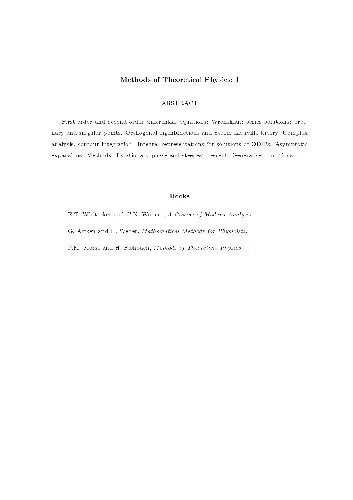
Introduction to 'Methods of Theoretical Physics 1' Welcome to the fascinating world of theoretical physics, as laid out in the comprehensive and masterful text, 'Methods of Theoretical Physics 1.' This book is an essential resource for anyone delving into the intricate mathema
Before you read
Welcome to the fascinating world of theoretical physics, as laid out in the comprehensive and masterful text, 'Methods of Theoretical Physics 1.' This book is an essential resource for anyone delving into the intricate mathematical frameworks and analytical techniques that underpin the field of physics. Written with a precise balance of rigor and clarity, it serves as a cornerstone reference for both advanced students and practicing physicists. Here, we present a structured overview of its purpose, key contents, and insights that have made it a pivotal work in the domain of scientific inquiry.
The book 'Methods of Theoretical Physics 1' is designed to equip readers with a profound understanding of the mathematical tools and theoretical frameworks that govern the behavior of physical systems. It focuses on the development and application of techniques such as differential equations, vector calculus, and complex variables, which are crucial for analyzing physical phenomena. Each chapter builds upon the mathematical foundations and applies these techniques to real-world problems, making the book both practical and mathematically enriching.
In the opening sections, the authors meticulously introduce foundational topics, including mathematical preliminaries and coordinate systems, before venturing into intricate discussions on specialized methods. Topics such as Green’s functions, boundary value problems, variational principles, and eigenvalue problems are explored with depth. By merging physical intuition with mathematical precision, the book impresses upon its readers the art of formulating and solving physical problems using advanced theoretical methods.
Additionally, 'Methods of Theoretical Physics 1' provides worked examples, carefully curated exercises, and detailed explanations, ensuring that readers can immediately implement and practice what they have learned. The text also highlights common pitfalls and misconceptions in theoretical problem-solving, offering practical insights for advancing one's skills.
The book contains numerous insightful quotes that speak to the beauty and utility of theoretical physics. Here are a few notable ones:
"Theoretical physics is not merely the application of mathematics to physical systems; it is the art of discovering which mathematics to apply, and when."
"Mathematical methods are not an end in themselves but are lenses through which the laws of nature come into focus."
"Understanding is achieved when complexity dissolves into simplicity, and equations transform into insight."
'Methods of Theoretical Physics 1' is not just a textbook—it is a gateway to understanding the mathematical bedrock of physics. Its enduring relevance lies in its unparalleled depth and clarity. Here’s why this book is so impactful:
The legacy of 'Methods of Theoretical Physics 1' is evident in its widespread influence across disciplines and its ability to inspire and guide generations of physicists and mathematicians. Whether you are advancing your studies, conducting high-level research, or exploring theoretical physics out of sheer curiosity, this book offers an invaluable resource that will expand your understanding and sharpen your analytical skills.
Your question is answered in the context of this title and author. Each answer uses 2 points.
0 reviews, 4.0 average out of 5
Sign in to publish a review.
Ask a focused question and learn from the community.
Related references that continue this learning path.
Giovanna Corsi,Maria Luisa Dalla Chiara,Gian Carlo Ghirardi (Editors)

Hugues Leblanc (auth.),Mathieu Marion,Robert S. Cohen (eds.)