

Bifurcation Theory: An Introduction with Applications to Partial Differential Equations
Hansjörg Kielhöfer (auth.)
2012
View book
Book guide and evaluation
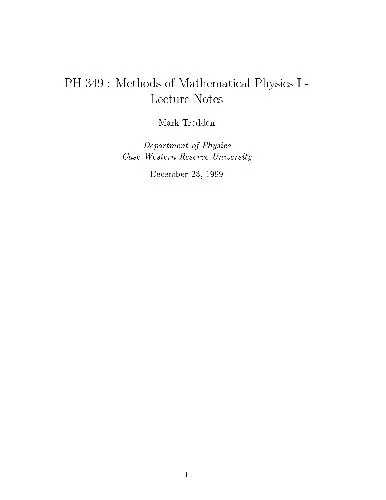
Trodden M.
0 reviews
Published
pages
views
Introduction Welcome to 'Methods of Mathematical Physics', a comprehensive guide crafted to navigate the intricate world of mathematical tools essential for physicists and engineers. This book is more than just a collection of theories; it's a bridge connecting the theoretical
Before you read
Welcome to 'Methods of Mathematical Physics', a comprehensive guide crafted to navigate the intricate world of mathematical tools essential for physicists and engineers. This book is more than just a collection of theories; it's a bridge connecting the theoretical world of mathematics with practical applications in physics.
The book 'Methods of Mathematical Physics' is an extensive resource that delves into the core mathematical techniques used in advanced physics. It explores a variety of topics such as differential equations, integral transforms, and complex variables. Every chapter is constructed with precision to unfold mathematical concepts progressively, making it easier for readers to grasp complex ideas without getting overwhelmed. The reader is introduced to linear algebra and calculus in early chapters, setting the foundation for more complicated topics like tensor analysis and perturbation theory. Unlike conventional physics books, this work emphasizes the seamless integration of mathematics in solving physical problems, thus preparing readers to apply mathematical thought processes effectively in their respective fields.
"The beauty of mathematics lies in its ability to simplify the complexity of the universe."
"Every physical theory starts as a page of mathematics; thus, every physicist must yearn to become a mathematician first."
'Methods of Mathematical Physics' is an essential text because it addresses the common gap between theoretical mathematics and practical physics. The educational landscape often isolates the two, leading to physicists who struggle with mathematical foundations and mathematicians who cannot translate their theories into practical solutions. This book serves as a crucial bridge, offering not just tools but a mindset for integrating mathematics seamlessly into physics and engineering challenges. In an era where interdisciplinary skills are increasingly valued, this book offers the comprehensive insight needed to excel and innovate in scientific endeavors.
Your question is answered in the context of this title and author. Each answer uses 2 points.
0 reviews, 4.7 average out of 5
Sign in to publish a review.
Ask a focused question and learn from the community.
Related references that continue this learning path.
Hansjörg Kielhöfer (auth.)
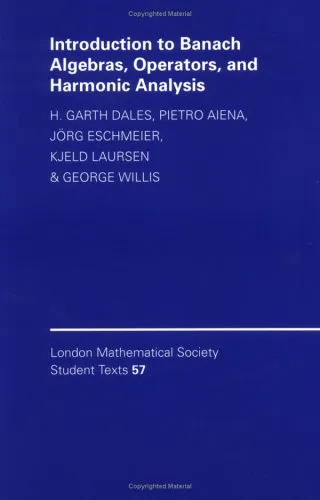
H. Garth Dales,Pietro Aiena,Jörg Eschmeier,Kjeld Laursen,George A. Willis


Vladimir Maz'ya,Vladimir Maz'ya