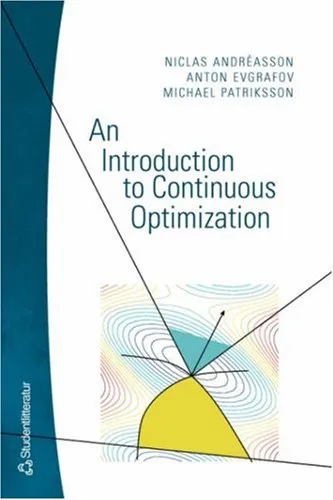
An introduction to continuous optimization: Foundations and fundamental algorithms
N. Andreasson,A. Evgrafov,M. Patriksson
2007
View book
Book guide and evaluation
Joel Franklin (auth.)
0 reviews
Published
pages
views
Introduction to "Methods of Mathematical Economics: Linear and Nonlinear Programming, Fixed-Point Theorems" Welcome to a journey through the fundamental techniques that govern the realm of mathematical economics. This book serves as a comprehensive guide to essential tools
Before you read
Welcome to a journey through the fundamental techniques that govern the realm of mathematical economics. This book serves as a comprehensive guide to essential tools such as linear and nonlinear programming and fixed-point theorems, which are pivotal in understanding and formulating economic models.
In today’s complex economic landscape, mathematical methods provide critical insights and solutions. This book focuses on the core methodologies that underlie modern economic theory. The exploration begins with linear programming, which is foundational for optimizing resources in economic models. As we delve deeper, nonlinear programming is introduced, offering an advanced view of scenarios where linear assumptions do not suffice.
Furthermore, the book discusses fixed-point theorems, which play a significant role in equilibrium analysis—a cornerstone of economic theory. By presenting these mathematical techniques, the book equips readers with the tools to solve real-world economic problems effectively.
Readers will gain a robust understanding of:
Here are some thought-provoking excerpts to reflect upon:
"Mathematical economics is not just about solving equations—it’s about understanding the nature of economic phenomena through a mathematical lens."
"The true power of an economist lies in their ability to model real-world complexities in a mathematical framework."
This book stands out because it not only addresses the technical aspects of mathematical economics but also provides context on why and how these methods are integral to real economic decision-making. By bridging the gap between theory and practice, it remains a vital resource for both students and professionals in the field.
The methodologies explored in this book are not just academic exercises; they are crucial for policymakers, business leaders, and researchers who seek to understand and innovate within the market economy. By mastering these techniques, readers can contribute to developing solutions for the economic challenges of today and tomorrow.
Your question is answered in the context of this title and author. Each answer uses 2 points.
0 reviews, 4.5 average out of 5
Sign in to publish a review.
Ask a focused question and learn from the community.
Related references that continue this learning path.
N. Andreasson,A. Evgrafov,M. Patriksson