Lectures on computational fluid dynamics, mathematical physics, and linear algebra
Gustafson K.,Abe T.,Kuwahara K. (eds.)
1997
View book
Book guide and evaluation
Alder B.,Ferndach S.,Rotenberg M.
0 reviews
Published
pages
views
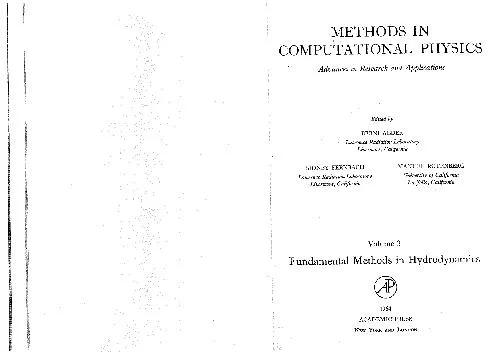
Welcome to a comprehensive exploration of 'Methods in Computational Physics. Fundamental Methods in Hydrodynamics,' an insightful title that delves deeply into the intricate world of hydrodynamics and computational physics. This book offers a robust foundation for understanding
Before you read
Welcome to a comprehensive exploration of 'Methods in Computational Physics. Fundamental Methods in Hydrodynamics,' an insightful title that delves deeply into the intricate world of hydrodynamics and computational physics. This book offers a robust foundation for understanding fundamental methods, perfect for students, researchers, and professionals eager to enhance their knowledge in the field.
In this groundbreaking work, the authors deftly unravel the complexities of computational methods applied to hydrodynamics. The book begins with an introduction to the fundamental principles of fluid dynamics, seamlessly transitioning to the computational techniques used to solve complex hydrodynamic problems. Each chapter builds upon the last, allowing readers to gradually develop a comprehensive understanding of computational hydrodynamics.
Key topics include numerical solutions to the Navier-Stokes equations, finite difference and finite volume methods, and the implementation of boundary conditions. The book also tackles advanced subjects such as turbulence modeling and multi-phase flows, making it an essential resource for tackling real-world hydrodynamic challenges. The authors blend theoretical insights with practical applications, providing an indispensable guide to both academic study and professional advancement.
"In the realm of computational physics, understanding the flow of fluids is akin to deciphering the very fabric of nature."
"The elegance of numerical methods lies in their ability to transform complex equations into demonstrable realities."
This book matters because it fills a critical niche in the literature of computational physics and hydrodynamics. It bridges the gap between basic principles and complex applications that professionals and academics often encounter. As hydrodynamics continues to play a pivotal role in various industries—ranging from environmental engineering to aerospace—understanding these computational methods is more crucial than ever.
Furthermore, the interdisciplinary approach taken by the authors ensures that readers from diverse scientific backgrounds can appreciate and apply the concepts discussed within. This broad appeal, combined with the book's methodical structure and clarity of presentation, makes it a pivotal resource for anyone looking to deepen their understanding of how computational techniques can solve hydrodynamic problems more effectively.
Embark on a journey through the depths of computational hydrodynamics and emerge with the knowledge and skills to tackle some of the most challenging fluid dynamics problems of our time. 'Methods in Computational Physics. Fundamental Methods in Hydrodynamics' is not merely a textbook—it is a vital tool for advancing in the field.
Your question is answered in the context of this title and author. Each answer uses 2 points.
0 reviews, 3.8 average out of 5
Sign in to publish a review.
Ask a focused question and learn from the community.
Related references that continue this learning path.
Gustafson K.,Abe T.,Kuwahara K. (eds.)