
Book guide and evaluation
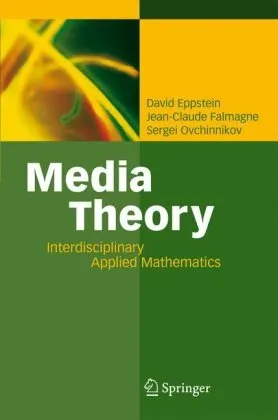
Media theory: interdisciplinary applied mathematics
David Eppstein,Jean-Claude Falmagne,Sergei Ovchinnikov (auth.)
English
Beginner
Mathematics
4.9 / 5
0 reviews
2008
Published
330
pages
246
views
Introduction to Media Theory: Interdisciplinary Applied Mathematics Welcome to Media Theory: Interdisciplinary Applied Mathematics, an exploration of the intricate relationship between mathematics, cognitive science, and social systems. Authored by esteemed researchers Dav
Before you read
What will you get from this book?
Introduction to Media Theory: Interdisciplinary Applied Mathematics
Welcome to Media Theory: Interdisciplinary Applied Mathematics, an exploration of the intricate relationship between mathematics, cognitive science, and social systems. Authored by esteemed researchers David Eppstein, Jean-Claude Falmagne, and Sergei Ovchinnikov, this book constructs a rich framework for understanding how information, ideas, and decisions propagate, evolve, and stabilize across various "media"—abstractly defined systems of interacting individuals or entities.
The book delves deeply into both the theoretical underpinnings and practical applications of media theory, a burgeoning interdisciplinary field. With its strong mathematical foundation, it is an essential text for researchers, students, and professionals in applied mathematics, computer science, artificial intelligence, social dynamics, and beyond. Beyond mathematics, the insights presented here have wide-ranging implications for understanding consensus, ranking systems, decision-making processes, and neural networks.
In the sections that follow, we provide a detailed introduction to the book's content, its significance, and its key messages. We hope this inside look at the book will pique your curiosity and encourage you to dive deeper into the fascinating world of media theory.
Detailed Summary of the Book
A comprehensive roadmap for media theory and its practical implications.
At its core, the book develops the formal concept of a medium. In mathematical terms, a medium is a structure that captures all possible ways of transforming one state (or configuration) into another. The authors present this theory step by step, starting from elementary examples such as reordering sequences or solving puzzles, and culminating in highly sophisticated applications like multi-agent systems and distributed decision-making frameworks.
The book balances rigorous theoretical investigation with accessible examples, ensuring readers from diverse backgrounds can appreciate its contributions. Early chapters focus on laying the groundwork by explaining the algebraic and combinatorial definitions of media, while later sections expand into dynamic systems, rewriting rules, and even applications to philosophy and cognitive science.
Discussions throughout the text are supported by mathematical proofs, illustrative worked examples, and thought-provoking problems—making the book as much an intellectual exercise as it is a learning resource. Readers will also uncover connections between media theory and other mathematical domains, such as graph theory, partially ordered sets, and finite state automata.
Key Takeaways
What readers can expect to learn and apply.
- Media theory provides a unifying framework for analyzing complex systems of transformation and decision-making.
- Easily translates to practical applications in artificial intelligence, ranking methods, and collaborative filtering.
- Helps model and understand the spread of ideas, preferences, and behaviors in social systems.
- Introduces novel algorithmic and mathematical tools for researchers and engineers alike.
- Offers a cross-disciplinary perspective linking mathematics with psychology, cognitive science, and philosophy.
Famous Quotes from the Book
Words of wisdom from the authors.
"A medium, in its essence, is not just a means of communication but a system of rules and structures that constrain and guide the evolution of states within it."
"When we unravel the transformations allowed by a medium, we reveal its hidden logic—a logic that shapes consensus, creativity, and conflict alike."
Why This Book Matters
The lasting impact and relevance of Media Theory.
Media Theory: Interdisciplinary Applied Mathematics stands out as a groundbreaking contribution to both theoretical and applied sciences. In an age dominated by data and algorithms, understanding how systems interact, evolve, and converge is more relevant than ever. This book provides the mathematical language necessary to describe these interactions and offers tools for addressing pressing challenges in fields like artificial intelligence, social science, and decision theory.
Beyond its scholarly contributions, the insights in this book challenge us to think critically about the systems surrounding us—from networks of influence in social media to mechanisms of consensus in organizations. By mastering the principles laid out in this book, readers will be armed with the knowledge to design, analyze, and improve systems in virtually any discipline.
Whether you are a mathematician, a systems theorist, or simply someone curious about the mathematical foundations of decision-making, this book offers a treasure trove of ideas and applications that will stay with you long after you put it down. It is a textbook, a guide, and a source of inspiration all in one.
Ask this book
Your question is answered in the context of this title and author. Each answer uses 2 points.
Sign in to ask the book assistant.
Reader reviews
0 reviews, 4.9 average out of 5
No reviews yet
If you have read this book, help the next reader with your experience.
Write a review
Sign in to publish a review.
Reader questions and answers
Ask a focused question and learn from the community.
Sign in to ask or answer a question.
No questions yet
Be the first to ask a clear, useful question.
What to read next
Related references that continue this learning path.


Modern Computer Vision with PyTorch: A Practical Roadmap From Deep Learning Fundamentals to Advanced Applications and Generative AI, 2nd Edition
V Kishore Ayyadevara,Yeshwanth Reddy
2023
View book