Conflict and Compromise: The Strategy, Politics and Diplomacy of the French Blockade, 1914–1918
Marjorie Milbank Farrar (auth.)
1974
View book
Book guide and evaluation
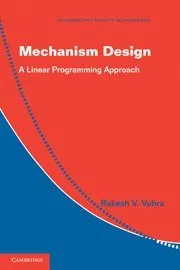
Rakesh V. Vohra
0 reviews
Published
pages
views
Introduction to Mechanism Design: A Linear Programming Approach "Mechanism Design: A Linear Programming Approach" by Rakesh V. Vohra is a pioneering work that explores the intricate field of mechanism design, a sub-discipline of game theory. The book provides a rigorous ye
Before you read
"Mechanism Design: A Linear Programming Approach" by Rakesh V. Vohra is a pioneering work that explores the intricate field of mechanism design, a sub-discipline of game theory. The book provides a rigorous yet approachable introduction to the subject, focusing on the mathematical foundations and practical applications of mechanism design. Anchored in the use of linear programming, this text bridges the gap between theory and practice, empowering readers to address real-world resource allocation and optimization problems using mathematical precision.
This book emphasizes simplicity and clarity while delving into one of the most intellectually stimulating areas of economics and operations research. It tackles complex problems by leveraging the power of linear programming, subsequently providing tools to design mechanisms that achieve specific outcomes, often in environments of strategic interaction. Whether a reader is an economist, computer scientist, mathematician, or engineer, this book serves as a valuable resource to understand how to approach and solve problems in an interdisciplinary manner.
The core premise of the book revolves around the design of incentives and rules to achieve desired outcomes in strategic environments. At its heart, mechanism design is about creating solutions that align individual incentives with overall welfare, even when participants act selfishly in their best interests. The book provides a clear pathway toward understanding how to formalize such problems mathematically and solve them using established tools like linear programming.
"Mechanism Design: A Linear Programming Approach" begins by introducing readers to the formal framework of mechanism design, contrasting it with traditional game theory, where the rules of interactions are fixed, and payoffs are analyzed. Instead, mechanism design allows the designer to create those rules in environments characterized by incomplete information. By emphasizing the use of linear programming, the book reveals how these mathematical methods can model and solve mechanism design problems with elegance and effectiveness.
Topics covered include auction theory, social choice theory, optimal allocation of resources, and incentive compatibility. The text guides readers through constructive examples and exercises, allowing them to build an intuitive understanding of key concepts. For instance, core problems such as maximizing revenue in an auction or ensuring fair resource allocation are explored with linear programming methodologies and practical insights. Additionally, the book highlights how linear programming duality provides deeper insights into the feasibility and limits of various mechanisms.
"Mechanism design begins where traditional game theory ends: it asks not what will happen, but what can be designed to happen."
"Incentives are the cornerstone of mechanism design, and they compel us to align individual goals with collective outcomes."
"Linear programming is not merely a mathematical tool—here, it becomes a language to articulate the design of systems and strategies."
"Mechanism Design: A Linear Programming Approach" occupies a unique position in the academic and professional literature of economics and game theory. While mechanism design is often considered an abstract and theoretical discipline, this book makes it approachable without compromising mathematical rigor. By focusing on linear programming, the text connects elegant theory with practical implementation.
The significance of the book extends beyond academics—it provides vital tools for addressing pressing global challenges, from fair resource allocation in developing economies to designing efficient marketplaces like eBay or Google Ads. Additionally, as blockchain technology and decentralized systems rise in prominence, the principles outlined in this book become even more relevant, guiding the design of protocols that are robust, fair, and efficient.
Economists, engineers, and computer scientists alike will find the book to be an indispensable guide to designing systems that tackle human needs and incentives head-on. As technology continues to reshape industries and societies, "Mechanism Design: A Linear Programming Approach" offers a timeless framework for those grappling with the question of how to design institutions that work for everyone.
Your question is answered in the context of this title and author. Each answer uses 2 points.
0 reviews, 4.5 average out of 5
Sign in to publish a review.
Ask a focused question and learn from the community.
Related references that continue this learning path.
Marjorie Milbank Farrar (auth.)

Friedel Bolle,Marco Lehmann-Waffenschmidt (auth.),Professor Dr. Friedel Bolle,Professor Dr. Marco Lehmann-Waffenschmidt (eds.)