

Book guide and evaluation
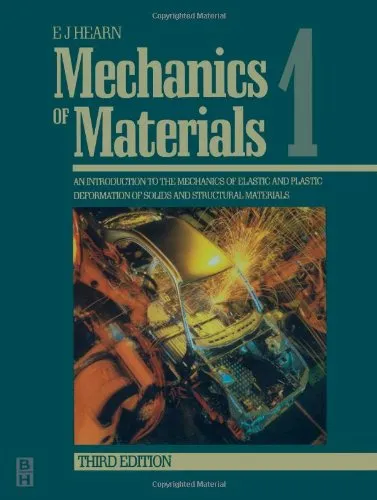
Mechanics of materials: an introduction to the mechanics of elastic and plastic deformation of solids and structural materials
E.J. Hearn
English
Beginner
Engineering
4.8 / 5
0 reviews
1997
Published
1038
pages
337
views
Introduction to Mechanics of Materials The field of mechanics of materials is fundamental to understanding how materials respond to external forces, whether they deform elastically, plastically, or fail under stress. "Mechanics of Materials: An Introduction to the Mechanics of
Before you read
What will you get from this book?
Introduction to Mechanics of Materials
The field of mechanics of materials is fundamental to understanding how materials respond to external forces, whether they deform elastically, plastically, or fail under stress. "Mechanics of Materials: An Introduction to the Mechanics of Elastic and Plastic Deformation of Solids and Structural Materials" by E.J. Hearn introduces readers to the foundational concepts of this crucial discipline, providing clear explanations and practical applications for engineers, students, and professionals alike.
In this comprehensive guide, the book outlines the essential principles underlying the behavior of materials subjected to various forces and moments. It bridges the gap between theoretical mechanics and practical engineering applications, delving into stress analysis, strain relationships, and the mechanical properties of common structural materials. With its logical flow, accessible language, and a balance of theoretical rigor and practical insights, this work has become an invaluable resource in engineering education and the industries it serves.
Detailed Summary
The book's overall aim is to provide a complete understanding of how materials behave when subjected to forces, from basic elastic deformation to complex plastic deformation scenarios. It begins by introducing the key concepts of stress and strain, ensuring readers have a thorough grasp of these foundational ideas. The basics of elasticity are explored in-depth, discussing Hooke's Law and the linear relationships that govern elastic behavior in materials.
The text transitions seamlessly into more advanced concepts, such as stress-strain relationships in multi-dimensional scenarios and the theory of torsion in circular shafts. Detailed explanations are provided for both elastic limits and yielding conditions, leading to the discussion of plastic deformation, where materials permanently change shape under applied loads. Throughout, the role of structural materials such as metals, composites, and polymers is emphasized, highlighting how material properties influence design decisions in engineering.
The book also covers essential topics like bending of beams, shear stresses in various cross-sections, buckling of columns, and energy methods in structural analysis. Additionally, fracture mechanics, fatigue, and creep are addressed, ensuring readers understand the life-cycle behavior of materials under prolonged or extreme conditions. Practical solved examples, exercises, and illustrative diagrams ensure the content is both engaging and relevant to real-world applications.
Key Takeaways
- Understand fundamental concepts of stress, strain, elasticity, and plasticity.
- Learn how to analyze stress-strain behavior in various types of materials and structures.
- Gain insights into critical engineering phenomena such as fatigue, fracture, and creep.
- Explore the mechanical properties of structural materials and their design implications.
- Develop problem-solving skills with practical examples and theoretical explanations.
Famous Quotes
"The behavior of materials under forces is not solely a matter of strength; it is also one of understanding their limits and responses, both temporary and permanent."
"Mechanics of materials bridges the gap between theoretical mechanics and practical engineering, serving as the foundation of design and construction in every field."
"Elastic and plastic deformations are not just academic concepts but critical factors in predicting material performance under real-world conditions."
Why This Book Matters
This book serves as a cornerstone for both aspiring engineers and seasoned professionals. Its importance lies in its ability to demystify complex topics while maintaining a level of technical precision essential for rigorous engineering applications. By combining theoretical principles with practical methodologies, E.J. Hearn has presented a text that doesn’t just educate—it equips learners to solve real-world challenges in industries such as civil engineering, mechanical engineering, aerospace, and manufacturing.
In an era where materials technology is rapidly evolving, understanding the mechanics of materials remains as relevant today as ever. This book empowers readers with the knowledge needed to design safer, more efficient, and economically viable structures. Whether it is designing aircraft components or constructing skyscrapers, the principles outlined in this book form the core of mechanical and structural integrity. The clarity of thought and the systematic approach provided within make it an irreplaceable resource in the engineering canon.
"Mechanics of Materials" continues to inspire and educate generations of engineers, grounding their knowledge in the practical realities of material performance. For those looking to deepen their understanding of this vital subject, this book provides not just information, but the tools to apply it effectively in solving engineering problems.
Ask this book
Your question is answered in the context of this title and author. Each answer uses 2 points.
Sign in to ask the book assistant.
Reader reviews
0 reviews, 4.8 average out of 5
No reviews yet
If you have read this book, help the next reader with your experience.
Write a review
Sign in to publish a review.
Reader questions and answers
Ask a focused question and learn from the community.
Sign in to ask or answer a question.
No questions yet
Be the first to ask a clear, useful question.
What to read next
Related references that continue this learning path.


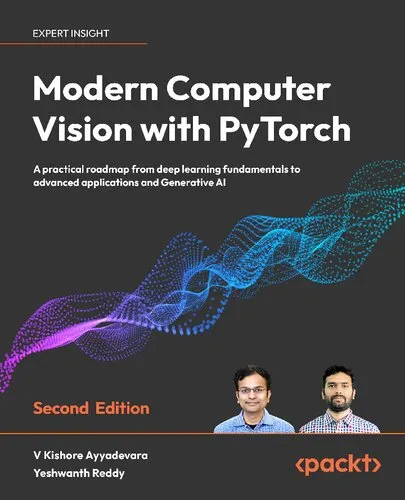
Modern Computer Vision with PyTorch: A Practical Roadmap From Deep Learning Fundamentals to Advanced Applications and Generative AI, 2nd Edition
V Kishore Ayyadevara,Yeshwanth Reddy
2023
View book