
Book guide and evaluation
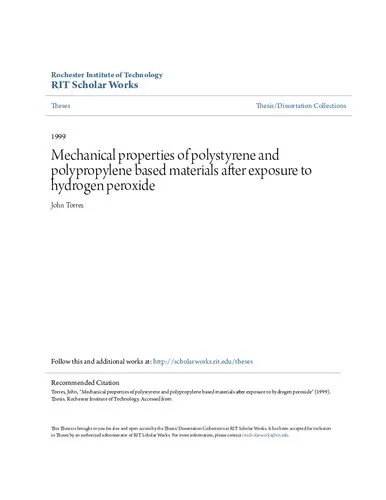
Mechanical properties of polystyrene and polypropylene based materials after exposure to hydrogen peroxide
John M. Torres
English
Beginner
Condensed Matter
4.5 / 5
0 reviews
1999
Published
126
pages
616
views
Introduction In the rapidly evolving world of materials science, understanding the behavior of polymers under various environmental conditions is crucial. 'Mechanical Properties of Polystyrene and Polypropylene Based Materials after Exposure to Hydrogen Peroxide' delves in
Before you read
What will you get from this book?
Introduction
In the rapidly evolving world of materials science, understanding the behavior of polymers under various environmental conditions is crucial. 'Mechanical Properties of Polystyrene and Polypropylene Based Materials after Exposure to Hydrogen Peroxide' delves into this specialized field, exploring how common materials respond to oxidative environments, specifically hydrogen peroxide.
Detailed Summary
Polystyrene and polypropylene are ubiquitous in our everyday lives, found in everything from packaging to automotive components. Despite their widespread use, there's a gap in the literature concerning their mechanical performance after long-term exposure to oxidizing agents. This book fills that gap by providing a comprehensive analysis of how these materials' structural and mechanical properties alter after hydrogen peroxide exposure.
The book begins by detailing the fundamental chemistry of polystyrene and polypropylene, offering readers a solid foundation to understand subsequent chapters. It explains the common manufacturing processes and the typical applications of these materials, setting the stage for understanding the implications of their degradation.
Subsequent chapters analyze experimental data and theoretical models to assess changes in properties such as tensile strength, elasticity, and impact resistance. Through meticulously conducted experiments and simulations, the book demonstrates how prolonged exposure can lead to microstructural changes that compromise material integrity. The findings have profound implications for industries relying on these polymers, guiding both material selection and product design.
Key Takeaways
- Understanding the oxidative degradation process of common polymers.
- Insight into the microstructural changes of materials due to hydrogen peroxide exposure.
- Methodologies for testing and evaluating mechanical properties post-exposure.
- Strategies for improving material resilience and product longevity.
Famous Quotes from the Book
"The resilience of a material is not determined by its initial strength, but by its endurance amidst adversity."
"Understanding degradation is not merely about identifying weaknesses; it's about discovering pathways to innovation."
Why This Book Matters
As sustainability becomes an increasing focus for industries worldwide, understanding material degradation is vital for developing eco-friendly, durable products. This book provides key insights for engineers, researchers, and manufacturers aiming to design next-generation materials that withstand harsh environments.
By elucidating potential vulnerabilities in widely used polymers, the book not only cautions against unanticipated failures but also suggests avenues for enhancement through material science innovation. Exploring degradation under oxidative conditions prepares stakeholders to make informed decisions, aligning with global efforts to extend product lifespans and reduce waste.
Ask this book
Your question is answered in the context of this title and author. Each answer uses 2 points.
Sign in to ask the book assistant.
Reader reviews
0 reviews, 4.5 average out of 5
No reviews yet
If you have read this book, help the next reader with your experience.
Write a review
Sign in to publish a review.
Reader questions and answers
Ask a focused question and learn from the community.
Sign in to ask or answer a question.
No questions yet
Be the first to ask a clear, useful question.
What to read next
Related references that continue this learning path.
Modern Many-Particle Physics: Atomic Gases, Quantum Dots and Quantum Fluids
Enrico Lipparini
2004
View book
Quantum Field Theory : Feynman Path Integrals and Diagrammatic Techniques in Condensed Matter
Fai,Lukong Cornelius
2020
View book
Topological Insulators and Topological Superconductors
B. Andrei Bernevig,Taylor L. Hughes
2013
View book