

Book guide and evaluation
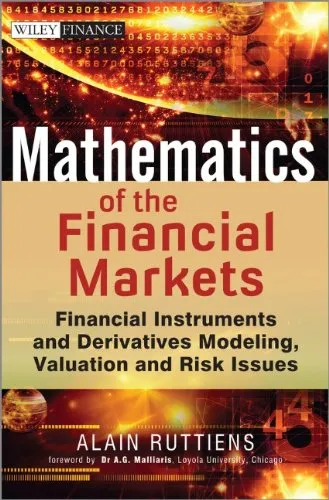
Mathematics of the Financial Markets: Financial Instruments and Derivatives Modelling, Valuation and Risk Issues
Alain Ruttiens
English
Beginner
Economics
4.9 / 5
0 reviews
2013
Published
351
pages
467
views
Introduction to "Mathematics of the Financial Markets" The financial markets have always been a complex, fascinating ecosystem where mathematics plays a pivotal role. My book, "Mathematics of the Financial Markets: Financial Instruments and Derivatives Modelling, Valuation and
Before you read
What will you get from this book?
Introduction to "Mathematics of the Financial Markets"
The financial markets have always been a complex, fascinating ecosystem where mathematics plays a pivotal role. My book, "Mathematics of the Financial Markets: Financial Instruments and Derivatives Modelling, Valuation and Risk Issues", aims to bridge the gap between mathematical theory and its practical application in finance. With a comprehensive approach, this book serves as both a guide for newcomers and a reference for seasoned professionals.
This book delves into the mathematical foundations of financial markets, unraveling the intricacies behind financial instruments, derivative valuation, and risk management techniques. With an emphasis on rigorous yet accessible explanations, readers will gain insights into how mathematical models can be employed to forecast, value, and manage financial assets in diverse market conditions. Whether you're a finance professional, an academic, or a student passionate about quantitative analysis, this book provides a robust framework for understanding the mechanics of the financial world.
Detailed Summary of the Book
The book is divided into several chapters, each focusing on a different aspect of financial markets and their mathematical underpinnings. It begins with an introduction to financial markets, their structure, and the instruments traded. From there, the discussion moves to the mathematical tools essential for modeling these instruments, including calculus, probability theory, and stochastic processes.
Key topics covered include:
- An overview of financial derivatives such as options, futures, and swaps.
- Valuation methods including the Black-Scholes model and binomial trees.
- Risk management techniques, focusing on Value at Risk (VaR) and hedging strategies.
- Applications of stochastic differential equations in finance.
- Insights into numerical methods for derivative pricing.
The book is punctuated with historical anecdotes about the development of finance as a quantitative discipline, helping readers contextualize the evolution of financial models within real-world events.
Key Takeaways
- A deep understanding of how mathematical models underpin the valuation of financial instruments.
- Practical insights into risk management in the context of volatile markets.
- Clarity on the pros and cons of various derivative pricing techniques, illustrated with examples.
- Enhanced theoretical knowledge coupled with methods for implementation in financial modeling software.
- Recognition of common pitfalls in quantitative finance and guidance on avoiding them.
By the end of the book, readers will have a strong grasp of how mathematical concepts form the foundation of modern finance, empowering them to make informed decisions in their professional pursuits.
Famous Quotes from the Book
"Mathematics is the language of logic in finance, transforming uncertainty into a field of calculated risk."
"The beauty of financial mathematics lies not in its complexity, but in its ability to simplify the chaos of markets into actionable insights."
Why This Book Matters
In an age where financial markets are becoming increasingly intricate and fast-paced, understanding their mathematical foundations is crucial. This book is more than just a theoretical exposition; it provides actionable knowledge that helps professionals navigate the challenges of modern finance. It empowers readers to not only comprehend the intricacies of pricing and risk but also to innovate and optimize their strategies using mathematical rigor.
Moreover, the book addresses common misunderstandings and pitfalls in the application of mathematical models to finance, fostering critical thinking and robust decision-making. Whether you're an aspiring quant, a financial engineer, or simply curious about the role of mathematics in markets, this book can serve as your roadmap to mastering these advanced concepts and applying them with confidence.
Ask this book
Your question is answered in the context of this title and author. Each answer uses 2 points.
Sign in to ask the book assistant.
Reader reviews
0 reviews, 4.9 average out of 5
No reviews yet
If you have read this book, help the next reader with your experience.
Write a review
Sign in to publish a review.
Reader questions and answers
Ask a focused question and learn from the community.
Sign in to ask or answer a question.
No questions yet
Be the first to ask a clear, useful question.
What to read next
Related references that continue this learning path.



Modern Computer Vision with PyTorch: A Practical Roadmap From Deep Learning Fundamentals to Advanced Applications and Generative AI, 2nd Edition
V Kishore Ayyadevara,Yeshwanth Reddy
2023
View book