

Book guide and evaluation
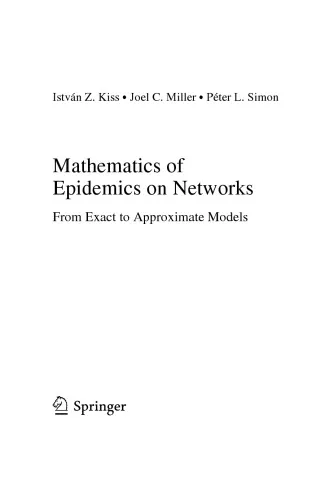
Mathematics of Epidemics on Networks. From Exact to Approximate Models
István Z. Kiss,Joel C. Miller,Péter L. Simon
English
Beginner
Mathematics
4.3 / 5
0 reviews
2017
Published
418
pages
144
views
Introduction to "Mathematics of Epidemics on Networks: From Exact to Approximate Models" Epidemics have shaped human history for millennia, and understanding their behavior is crucial for developing effective intervention strategies. In this book, "Mathematics of Epidemics on
Before you read
What will you get from this book?
Introduction to "Mathematics of Epidemics on Networks: From Exact to Approximate Models"
Epidemics have shaped human history for millennia, and understanding their behavior is crucial for developing effective intervention strategies. In this book, "Mathematics of Epidemics on Networks: From Exact to Approximate Models," we explore the dynamic interplay between mathematical theory, computational models, and real-world networked systems to offer an in-depth understanding of the mathematical underpinnings of epidemiological processes.
Designed for researchers, students, and professionals from diverse fields such as epidemiology, applied mathematics, physics, and data science, this book bridges the gap between theory and practice. It delivers a comprehensive framework for modeling the spread of infectious diseases in populations represented as complex networks, ranging from exact solutions to highly scalable approximations.
Networks are at the heart of modern epidemiological research. From human interactions to the spread of information and viruses, networks provide a way to capture the structural complexity of real-world systems. The book balances the rigorous mathematical techniques used to analyze epidemic processes with intuitive explanations and illustrative examples to make the material accessible to a broad audience.
Detailed Summary of the Book
The core content of "Mathematics of Epidemics on Networks" is centered around the modeling of disease spread in networks – formally structured representations of relationships between individuals, communities, or even regions. The book begins by introducing the basic epidemiological models such as the SIR, SIS, and SEIR types, and then extends these to settings where individuals are represented as nodes in a graph, with edges denoting connections along which infections may spread.
The narrative flows seamlessly from deterministic models, solved using differential equations, to stochastic approaches driven by randomness, which are imperative for realistic simulations. Additionally, the book doesn't shy away from tackling complexities such as heterogeneous networks, time-varying structures, and hybrid systems.
The transition from exact modeling to approximation methods marks one of the key contributions of this text. Exact models offer mathematical precision but suffer from high computational costs, especially for large networks. Approximation techniques such as moment-closure methods, mean-field analysis, and pairwise modeling reduce this burden while maintaining sufficient accuracy for practical purposes. These methods are described in great detail with step-by-step derivations, accompanied by diagrams, numerical results, and case studies.
In the later chapters, real-world applications are discussed, including the spread of diseases like influenza, COVID-19, and others, highlighting how network epidemiology informs and shapes public health policies. The book concludes with discussions on open problems, fueling further research in this exciting interdisciplinary field.
Key Takeaways
- A robust understanding of the mathematical models used to describe disease dynamics on networks.
- Insights into the transition from exact solutions to approximate models for scalability and efficiency.
- Practical tools and frameworks to study real-world epidemics and evaluate theoretical predictions against observed data.
- Applications of network epidemiology in public health, from mitigation strategies to vaccination policies.
- Critical discussions on methodological limitations and areas for future research.
Famous Quotes from the Book
"The complexity of epidemics on networks is a double-edged sword: it offers incredible opportunities to model behaviors grounded in reality while demanding robust mathematical tools to understand them."
"Approximation methods are not merely a convenience; they are a necessity when bridging the gap between theoretical exploration and practical, real-world applicability."
Why This Book Matters
The significance of "Mathematics of Epidemics on Networks" extends far beyond academic interest. With the recent global COVID-19 pandemic underscoring the importance of disease modeling, this book equips readers with analytical tools to better understand and manage the spread of infectious diseases. It has implications for public health strategies, resource allocation, and crisis management, making it a critical resource for policymakers and researchers alike.
The interdisciplinary nature of this text ensures that it appeals to practitioners from a variety of fields. The blend of rigorous mathematics, computational methodologies, and real-world relevance transforms the book into a unique resource for advancing both theoretical insights and practical interventions.
Additionally, by covering the full gradient from exact models to scalable approximations, the book offers solutions suitable for networks of all sizes and complexities. With epidemics becoming a growing threat due to globalization and urbanization, the frameworks outlined in this book are more relevant than ever.
Ask this book
Your question is answered in the context of this title and author. Each answer uses 2 points.
Sign in to ask the book assistant.
Reader reviews
0 reviews, 4.3 average out of 5
No reviews yet
If you have read this book, help the next reader with your experience.
Write a review
Sign in to publish a review.
Reader questions and answers
Ask a focused question and learn from the community.
Sign in to ask or answer a question.
No questions yet
Be the first to ask a clear, useful question.
What to read next
Related references that continue this learning path.


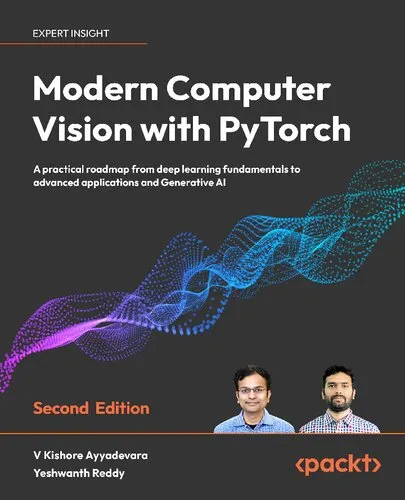
Modern Computer Vision with PyTorch: A Practical Roadmap From Deep Learning Fundamentals to Advanced Applications and Generative AI, 2nd Edition
V Kishore Ayyadevara,Yeshwanth Reddy
2023
View book