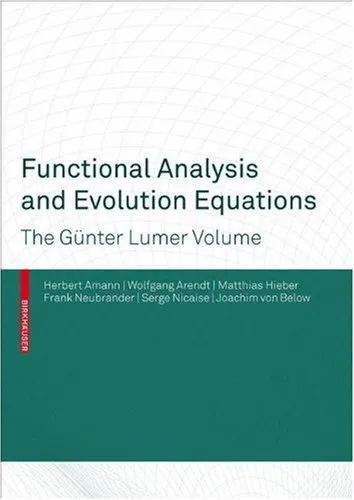
Functional analysis and evolution equations: The Gunter Lumer volume
Herbert Amann,Wolfgang Arendt,Matthias Hieber,Frank Neubrander,Serge Nicaise,Joachim Below
2008
View book

Book guide and evaluation
George Polya
0 reviews
Published
pages
views
Introduction to "Mathematics and Plausible Reasoning: Induction and Analogy in Mathematics" George Pólya’s "Mathematics and Plausible Reasoning: Induction and Analogy in Mathematics" is a timeless exploration into the art of mathematical reasoning. This seminal text delves
Before you read
George Pólya’s "Mathematics and Plausible Reasoning: Induction and Analogy in Mathematics" is a timeless exploration into the art of mathematical reasoning. This seminal text delves into two pivotal methods of acquiring knowledge and solving problems in mathematics: induction and analogy. Written with clarity and depth, the book is an invaluable resource for mathematicians, educators, and students who are eager to develop a deeper understanding of problem-solving approaches and the philosophies that underpin mathematical inquiry.
Pólya takes readers on an intellectual journey through the core principles of reasoning that are fundamental not just to mathematics but also to science, logic, and everyday decision-making. With an emphasis on the thought processes that guide discoveries, the book bridges the gap between logical deduction and creative, heuristic strategies. "Mathematics and Plausible Reasoning" reveals how patterns, analogies, and inductive reasoning work together to inspire solutions and innovation.
"Mathematics and Plausible Reasoning: Induction and Analogy in Mathematics" is the first volume of a two-part treatise on the nature of reasoning within mathematics. It emphasizes the practice of plausible reasoning, which contrasts sharply with formal deductive logic. Pólya establishes that plausible reasoning is not purely guesswork but is grounded in systematic and rational thought processes.
The book begins by examining inductive reasoning, where knowledge is generalized based on specific observations. Pólya demonstrates how mathematicians often observe patterns or trends within known data and then extend those patterns to formulate conjectures. These conjectures, while not yet proven, often guide further research and exploration.
The second half of the book focuses on analogy, which Pólya describes as another indispensable heuristic tool. By identifying similarities between different mathematical problems or concepts, mathematicians can transfer knowledge from one domain to another, shedding light on problems in unexpected ways. Examples are drawn from a variety of mathematical disciplines, illustrating how analogies can pave the way for breakthroughs.
Through a methodical analysis of historical mathematical developments, Pólya provides insights into how great mathematicians of the past utilized induction and analogy to arrive at elegant solutions. His case studies not only serve as educational tools but also inspire readers to adopt these methods in their own problem-solving endeavors.
"Mathematics presented with rigor is too difficult in the beginning and too late in the end."
"A great discovery solves a great problem but there is a grain of discovery in the solution of any problem."
"The aim of mathematics is to explain phenomena, to discover relations, and to predict outcomes."
George Pólya’s "Mathematics and Plausible Reasoning" is not just a mathematics book; it is a guide to thinking and reasoning effectively. The principles it discusses extend far beyond the confines of mathematics and can enhance analytical reasoning in fields such as science, philosophy, and engineering. By emphasizing the importance of induction and analogy, Pólya invites readers to ponder the creative and exploratory aspects of problem-solving alongside its logical structure.
The book matters because it provides a fresh perspective on how discoveries are made, offering actionable insights into improving one’s reasoning skills. Unlike many traditional mathematical texts that emphasize final proofs and solutions, Pólya shifts the focus to the process—the dynamic journey of moving from questions to ideas, and eventually to solutions. This makes the book a valuable asset not only for those studying mathematics but also for anyone interested in developing critical thinking skills.
Your question is answered in the context of this title and author. Each answer uses 2 points.
0 reviews, 4.7 average out of 5
Sign in to publish a review.
Ask a focused question and learn from the community.
Related references that continue this learning path.
Herbert Amann,Wolfgang Arendt,Matthias Hieber,Frank Neubrander,Serge Nicaise,Joachim Below
Jae-Hyeong Bae,Won-Gil Park (auth.),Themistocles M. Rassias (eds.)