

Book guide and evaluation
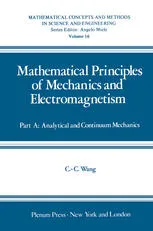
Mathematical Principles of Mechanics and Electromagnetism: Part A: Analytical and Continuum Mechanics
Chao-Cheng Wang (auth.)
English
Beginner
Data Science
4.5 / 5
0 reviews
1979
Published
215
pages
190
views
Introduction to 'Mathematical Principles of Mechanics and Electromagnetism: Part A: Analytical and Continuum Mechanics' This book seeks to bridge the intricate fields of mechanics and electromagnetism through a rigorous mathematical foundation. In 'Mathematical Principles of M
Before you read
What will you get from this book?
Introduction to 'Mathematical Principles of Mechanics and Electromagnetism: Part A: Analytical and Continuum Mechanics'
This book seeks to bridge the intricate fields of mechanics and electromagnetism through a rigorous mathematical foundation. In 'Mathematical Principles of Mechanics and Electromagnetism: Part A: Analytical and Continuum Mechanics,' I have aimed to provide both students and professionals with the tools to understand these interconnected disciplines deeply and systematically. Whether you are a seasoned scholar or an aspiring learner, this comprehensive volume is designed to enhance your grasp of the underlying principles that govern both physical and mathematical phenomena.
Detailed Summary of the Book
This first part of the series delves deeply into analytical and continuum mechanics, laying the groundwork for the study of more advanced topics in electromagnetism and other branches of physics. The book primarily focuses on the mathematical principles that underlie mechanical systems, emphasizing analytical approaches, the formulation of physical laws, and their applications in various scenarios.
The book is divided into several key areas of focus:
- Analytical Mechanics: This section explores the foundations of Lagrangian and Hamiltonian mechanics, introducing the reader to methodologies that simplify complex systems through generalized coordinates and variational principles.
- Continuum Mechanics: Building on physical intuition, this segment offers a mathematically rigorous approach to the properties and behaviors of deformable bodies, fluid dynamics, and solid mechanics. Key topics include stress and strain tensors, constitutive relations, and the conservation laws of mass, momentum, and energy.
- Mathematical Frameworks: Throughout the text, I integrate advanced mathematical tools such as tensor calculus, functional analysis, and differential geometry, ensuring the reader can connect theoretical constructs to applied scenarios.
By the end of the book, readers will have a thorough understanding of analytical and continuum mechanics, equipping them to tackle interdisciplinary applications and more specialized studies in electromagnetism, materials science, and beyond.
Key Takeaways
- The unification of physics and mathematics is essential for understanding the complexities of mechanics and electromagnetism.
- Lagrangian and Hamiltonian mechanics provide powerful tools for simplifying and analyzing dynamic systems.
- Continuum mechanics forms the foundation for studying the behavior of solids and fluids in real-world engineering and scientific applications.
- Mastering mathematical techniques such as tensor calculus and variational principles is critical for solving advanced problems in physics.
- This volume encourages a systematic and analytical mindset, enabling readers to approach challenging theoretical and practical problems with confidence.
Famous Quotes from the Book
"Mechanics is not mere motion; it is the poetry of nature, expressed in the language of mathematics."
"To embrace the continuum is to embrace the infinite granularity of nature, bounded by laws that are beautifully simple yet deceptively profound."
"The elegance of analytical mechanics lies in its ability to render the most intricate systems as a dance of equations."
Why This Book Matters
In an era where interdisciplinary research is the key to innovation, having a strong foundation in both mechanics and electromagnetism is paramount for scientists, engineers, and mathematicians alike. This book stands out because it combines the abstract formalism of mathematics with the concrete realities of physical systems.
By focusing on the principles that govern both analytical and continuum mechanics, this work equips readers with the theoretical tools to handle advanced problems in fields ranging from aerospace engineering to materials science. Moreover, the detailed mathematical explanations and structured approach to problem-solving make it an invaluable resource for academic coursework, research, and professional development. I wrote this book with the conviction that a deeper understanding of these principles fosters not only intellectual growth but also practical innovation that can benefit society at large.
Whether you aim to pursue academic excellence, contribute to cutting-edge research, or solve complex engineering challenges, this book will serve as a foundation on which your knowledge and curiosity can flourish.
Ask this book
Your question is answered in the context of this title and author. Each answer uses 2 points.
Sign in to ask the book assistant.
Reader reviews
0 reviews, 4.5 average out of 5
No reviews yet
If you have read this book, help the next reader with your experience.
Write a review
Sign in to publish a review.
Reader questions and answers
Ask a focused question and learn from the community.
Sign in to ask or answer a question.
No questions yet
Be the first to ask a clear, useful question.
What to read next
Related references that continue this learning path.



Modern Computer Vision with PyTorch: A Practical Roadmap From Deep Learning Fundamentals to Advanced Applications and Generative AI, 2nd Edition
V Kishore Ayyadevara,Yeshwanth Reddy
2023
View book