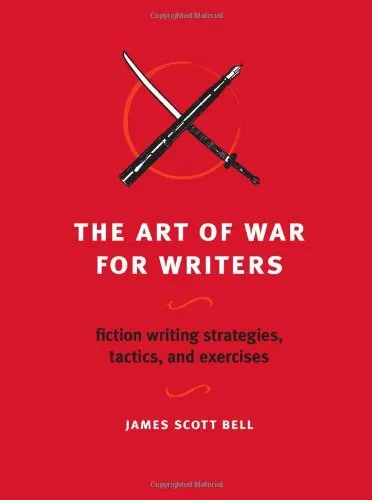
The Art of War for Writers: Fiction Writing Strategies, Tactics, and Exercises
James Scott Bell
2009
View book
Book guide and evaluation
Rene Cori,Daniel Lascar,Donald H. Pelletier
0 reviews
Published
pages
views
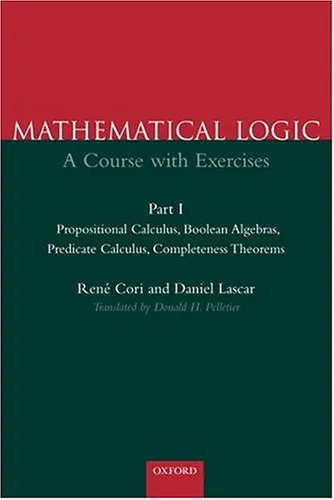
Introduction to "Mathematical Logic: A Course with Exercises Part I" Mathematics and logic have always gone hand in hand, delving into the underlying frameworks that define and structure mathematical thought. "Mathematical Logic: A Course with Exercises Part I: Proposition
Before you read
Mathematics and logic have always gone hand in hand, delving into the underlying frameworks that define and structure mathematical thought. "Mathematical Logic: A Course with Exercises Part I: Propositional Calculus, Boolean Algebras, Predicate Calculus, Completeness Theorems" is a fundamental text for those aspiring to understand this rich interplay. In this introduction, we aim to provide a detailed overview of this textbook, highlighting its key contributions to the field of mathematical logic, and outlining its relevance to students and researchers alike.
This book offers a comprehensive exploration of mathematical logic and serves as an introductory text for students stepping into the world of propositional calculus, Boolean algebras, predicate calculus, and completeness theorems. Designed as a structured course with exercises, this book facilitates both self-study and classroom learning. The journey begins with an analysis of propositional calculus, laying the groundwork for understanding logical statements and their relationships. Through meticulous explanations and examples, readers gradually familiarize themselves with the principles and nuances of Boolean algebras, a domain where logic intertwines with algebraic structures.
Subsequently, the book transitions to predicate calculus, presenting it as a robust extension of propositional calculus. Predicate calculus delves deeper, accommodating more complex expressions involving variables and quantifiers. The book articulates these concepts with precision, allowing readers to grasp both the syntax and semantics involved.
The exploration culminates in an in-depth discussion of completeness theorems, which are pivotal in proving the consistency and axiomatizability of logical systems. Completeness theorems assure us that logical deductions made within formal systems are sound, establishing a crucial link between theory and practice. Throughout, the book intertwines theoretical exposition with practical exercises, reinforcing understanding and ensuring mastery.
"To learn mathematics is to construct relationships, not just to receive a ready-made package."
"The language of logic is universal; it transcends the boundaries of individual human languages."
"Mathematical Logic: A Course with Exercises Part I" is an essential text for anyone engaged in the fields of mathematics, computer science, and related disciplines where logic acts as a foundation. Its precise and methodical approach to fundamental mathematical logic concepts makes it an invaluable resource for undergraduate students as well as advanced scholars. By bridging theoretical constructs with practical application, it equips readers with the tools needed to pursue further study or professional work in logical systems, computer programming, algorithmic design, and beyond.
The book stands out not only for its clear exposition but also for its inclusion of exercises that challenge the reader to engage deeply with the material. Through practical application, readers reinforce their learning and develop the analytical skills necessary to navigate and innovate within the realms of logic and mathematics.
In conclusion, this book is a beacon for those embarking on the path of mathematical logic. It is a guide and companion, leading the reader through the intricate landscapes of formal logical systems, ensuring they emerge not only as learners of mathematics but as thinkers of logic.
Your question is answered in the context of this title and author. Each answer uses 2 points.
0 reviews, 4.5 average out of 5
Sign in to publish a review.
Ask a focused question and learn from the community.
Related references that continue this learning path.
James Scott Bell