

Book guide and evaluation
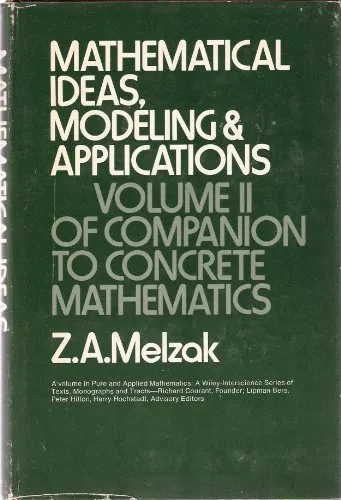
Mathematical Ideas, Modeling & Applications: Volume II of Companion to Concrete Mathematics
Zdzislaw Alexander Melzak
English
Beginner
Art
4.5 / 5
0 reviews
1976
Published
439
pages
195
views
Introduction to "Mathematical Ideas, Modeling & Applications: Volume II of Companion to Concrete Mathematics" Welcome to an in-depth exploration of mathematical thought, lucid modeling techniques, and real-world applications, as presented in "Mathematical Ideas, Modeling &
Before you read
What will you get from this book?
Introduction to "Mathematical Ideas, Modeling & Applications: Volume II of Companion to Concrete Mathematics"
Welcome to an in-depth exploration of mathematical thought, lucid modeling techniques, and real-world applications, as presented in "Mathematical Ideas, Modeling & Applications: Volume II of Companion to Concrete Mathematics". This book seeks to bridge the gap between abstract mathematical theory and practical implementation, building on its predecessor by diving deeper into the heart of applied mathematics and its many interdisciplinary facets. Whether you are a curious student, an academic researcher, or a practitioner in fields ranging from engineering to economics, the insights drawn from this volume are designed to illuminate the practical essence of concrete mathematics.
Detailed Summary of the Book
Mathematics is often seen as a collection of rigid formulas and fixed theories, but at its core, it is a highly creative discipline. This book demonstrates this creativity by focusing on mathematical modeling and highlighting how abstract constructs can be translated into solutions for real-world problems. Starting from foundational ideas and moving toward advanced applications, the text captures the interplay between formal mathematical structures and the messy, dynamic realities they help address.
The book unfolds in several sections, each addressing different aspects of applied mathematics. Topics such as optimization, approximation techniques, and stochastic models are thoroughly explored. The book also delves into the geometry of physical phenomena, offering perspectives on simplifying and solving complex problems. As a continuation of Companion to Concrete Mathematics: Volume I, this volume emphasizes problem-solving skills and connects theoretical insights to domains like physics, biology, economics, and computer science.
Readers will gain a deeper appreciation for the utility of mathematics in explaining phenomena and predicting outcomes. The overarching goal of the book is to nurture a habit of thinking that transcends rote calculation and focuses on the structural and conceptual power of mathematics when applied to practical scenarios.
Key Takeaways
- Understand the principles of mathematical modeling and their applications in various disciplines.
- Learn methods for approximations and their importance in solving real-world problems with incomplete data.
- Explore rigorous yet practical problem-solving strategies that blend theoretical and applied perspectives.
- Get insights into the connections between geometry, physics, and other sciences.
- Approach complex systems with confidence, breaking them down through structured mathematical reasoning.
Famous Quotes from the Book
"Mathematics is not merely a tool for computation, but a lens through which the complexity of the world becomes comprehensible."
"Without modeling, our understanding of phenomena would remain abstract; with it, we move from abstraction to action."
Why This Book Matters
In a world increasingly driven by data, computational power, and interdisciplinary collaboration, the ability to model, analyze, and implement mathematical constructs has become a critical skill set. This book matters because it equips readers not only with the technical skills needed to tackle complex problems but also with the conceptual frameworks necessary to approach those problems creatively and effectively.
Furthermore, Mathematical Ideas, Modeling & Applications emphasizes that mathematics is not an isolated discipline, but a field with profound implications for the physical and social sciences. It fosters a holistic appreciation for how mathematical tools and techniques impact decision-making, innovation, and progress in diverse domains. By grounding abstract theory in practical examples, this book remains accessible and highly relevant to both newcomers and seasoned mathematicians eager to explore new frontiers.
Whether you’re pursuing a deeper engagement with problem-solving or simply aiming to broaden your mathematical horizon, this volume will inspire you to see mathematics as a dynamic and indispensable force in shaping the world around us.
Ask this book
Your question is answered in the context of this title and author. Each answer uses 2 points.
Sign in to ask the book assistant.
Reader reviews
0 reviews, 4.5 average out of 5
No reviews yet
If you have read this book, help the next reader with your experience.
Write a review
Sign in to publish a review.
Reader questions and answers
Ask a focused question and learn from the community.
Sign in to ask or answer a question.
No questions yet
Be the first to ask a clear, useful question.
What to read next
Related references that continue this learning path.


Modern Computer Vision with PyTorch: A Practical Roadmap From Deep Learning Fundamentals to Advanced Applications and Generative AI, 2nd Edition
V Kishore Ayyadevara,Yeshwanth Reddy
2023
View book