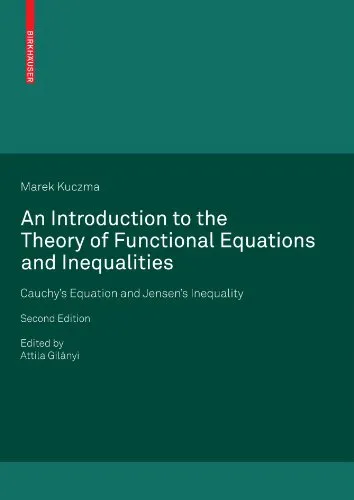
An introduction to the theory of functional equations and inequalities
Marek Kuczma,Attila Gilányi
2008
View book
Book guide and evaluation
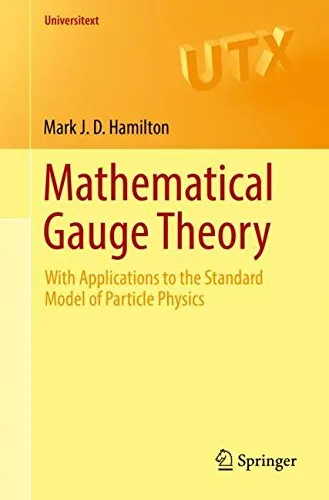
Mark J.D. Hamilton
0 reviews
Published
pages
views
Introduction to 'Mathematical Gauge Theory: With Applications to the Standard Model of Particle Physics' Mathematical Gauge Theory: With Applications to the Standard Model of Particle Physics is a comprehensive exploration of one of the most elegant and profound framewor
Before you read
Mathematical Gauge Theory: With Applications to the Standard Model of Particle Physics is a comprehensive exploration of one of the most elegant and profound frameworks in modern theoretical physics and mathematics. This book serves as a rigorous bridge between abstract mathematical concepts and their real-world physics applications, specifically in understanding the Standard Model, which is the cornerstone of particle physics. Whether you are a physicist seeking a deeper mathematical understanding or a mathematician eager to see theory brought to life, this book offers something for every reader.
Gauge theory is, at its heart, the study of symmetries. These symmetries underpin many of the fundamental interactions in the universe, and the Standard Model of particle physics—encompassing electromagnetism, the weak nuclear force, and the strong nuclear force—relies on gauge theories as its foundational framework. With this book, readers are guided through the mathematical structures that give rise to these symmetries, enabling a sophisticated and unified understanding of the quantum world.
The book begins with a thorough introduction to the underlying mathematical tools, such as differential geometry, Lie groups, and fiber bundles. These are the language and structure of gauge theories, offering a formal framework to describe how fields and particles behave under symmetry transformations.
Building on this foundation, the text delves into the key equations governing gauge theory, including the Yang-Mills equations and their role in describing fundamental forces. The mathematical exposition is presented in a way that prioritizes clarity, complemented by intuitive explanations tied directly to physical phenomena.
The heart of the book lies in its application to the Standard Model of particle physics. You'll find a detailed investigation of how the SU(3) × SU(2) × U(1) symmetry group encapsulates the interactions of quarks, leptons, and gauge bosons. Key topics include quantum chromodynamics (QCD) for the strong force and the electroweak theory, which unifies the weak nuclear force and electromagnetism.
Throughout, the book emphasizes not only the final results but also the derivations and reasoning behind these theories. Each chapter is filled with worked-out examples, exercises, and insights into open questions in modern research. The text also explores how gauge theory principles extend into newer areas, such as grand unified theories (GUTs) and the ongoing quest for a theory of quantum gravity.
"In the language of gauge theory, symmetry is not merely a property of the physical world—it is the guiding principle that dictates its laws."
"While the mathematical rigor of gauge theory is undeniable, its true beauty lies in its power to describe nature at its most fundamental level."
"The unification of symmetries in the Standard Model represents one of humanity's most profound achievements, rooted in both physics and mathematics."
Gauge theory is a cornerstone of modern physics, and understanding it is essential for anyone working in the fields of particle physics, quantum field theory, or advanced mathematics. However, the mathematical formalism required to truly grasp it can often seem daunting to non-specialists. This book bridges that gap, presenting the material in a way that is both accessible and rigorous.
Additionally, the Standard Model of particle physics, built upon the foundations of gauge theory, is a crowning achievement of theoretical physics. Despite its success, it is not the complete picture of our universe. The concepts explored in this text—ranging from the Higgs boson to the unresolved mysteries of dark matter and quantum gravity—are central to ongoing research. This book equips readers with the tools they need to contribute meaningfully to this frontier.
By weaving together mathematics and physical intuition, Mathematical Gauge Theory: With Applications to the Standard Model of Particle Physics stands as an invaluable resource for advanced students, researchers, and anyone intrigued by the mathematical structures underlying the universe.
Your question is answered in the context of this title and author. Each answer uses 2 points.
0 reviews, 4.0 average out of 5
Sign in to publish a review.
Ask a focused question and learn from the community.
Related references that continue this learning path.
Marek Kuczma,Attila Gilányi
Palaniappan Kannappan (auth.)
Jae-Hyeong Bae,Won-Gil Park (auth.),Themistocles M. Rassias (eds.)