
Book guide and evaluation
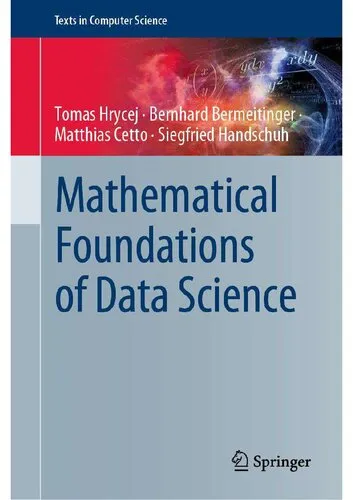
Mathematical Foundations of Data Science
Tomas Hrycej,Bernhard Bermeitinger,Matthias Cetto,Siegfried Handschuh
English
Beginner
Art
4.4 / 5
0 reviews
2023
Published
219
pages
276
views
Introduction Data science is a transformational force in today’s world, driving innovation, automation, and decisions for industries ranging from healthcare to finance. At the very core of this exciting field lies mathematics, acting as the backbone of algorithms, models,
Before you read
What will you get from this book?
Introduction
Data science is a transformational force in today’s world, driving innovation, automation, and decisions for industries ranging from healthcare to finance. At the very core of this exciting field lies mathematics, acting as the backbone of algorithms, models, and methods that enable us to extract insights from data. The book Mathematical Foundations of Data Science delves deeply into the rigorous mathematical concepts that underpin the field, bridging theoretical frameworks with practical applications. Whether you’re a budding data scientist, an experienced professional, or just an enthusiast eager to explore the discipline, this book is designed to enhance your understanding of the mathematical principles that make modern data science possible.
Through a structured and comprehensive approach, the authors provide insights into the essential aspects of linear algebra, calculus, probability theory, optimization, and statistical learning, all tailored to the unique challenges of data science. With step-by-step explanations, worked-out examples, and exercises that encourage hands-on learning, readers are not only introduced to core principles but also equipped to apply them to contemporary real-world problems.
Detailed Summary of the Book
The book is organized into logical sections that build upon each other, ensuring readers are guided from foundational concepts to advanced methodologies. The early chapters explore the basics of linear algebra and matrix operations, essential for understanding data manipulation and transformation. Similarly, multivariate calculus is presented with a focus on optimization problems, which form the heart of many machine-learning algorithms.
In subsequent chapters, probability and statistics are introduced to explain the stochastic nature of data, covering essential topics like random variables, probability distributions, and hypothesis testing. Specialized sections connect these concepts to machine learning techniques such as regression, classification, and clustering. Emphasis is also placed on convex optimization and gradient-based optimization techniques, key to training models efficiently.
What sets this book apart is its commitment to bridging theory with practice. Real-world applications such as dimensionality reduction, natural language processing, and neural networks are explored in detail, providing a well-rounded perspective on data science workflows. Each chapter concludes with exercises, ranging from conceptual proofs to coding challenges, to solidify understanding.
Key Takeaways
- Deep understanding of linear algebra and its critical role in data transformations, model representation, and dimensionality reduction.
- Insight into optimization techniques, from gradient descent to second-order methods, that power modern machine learning algorithms.
- Comprehensive coverage of probability theory and statistics for making sound data-driven decisions under uncertainty.
- Hands-on examples connecting theoretical principles to practical implementations in Python, MATLAB, or R.
- Foundational knowledge to explore advanced fields, such as deep learning, reinforcement learning, and unsupervised learning.
Famous Quotes from the Book
"The beauty of data science lies in the seamless integration of mathematics and technology to uncover hidden patterns that would otherwise remain invisible to the human eye."
"Understanding the mathematics behind optimization transforms it from being an engineering choice to a well-informed strategy."
Why This Book Matters
In an era dominated by data, understanding the mathematical principles behind data science and machine learning is crucial for anyone looking to thrive in tech-driven industries. While many books and resources focus on providing programming tutorials or high-level overviews, Mathematical Foundations of Data Science dives into the mathematical core, providing readers with a deeper appreciation of the “why” behind the methods.
Additionally, as artificial intelligence and machine learning continue to reshape industries, there is immense value in understanding the theoretical framework that underpins them. This book empowers readers with a complete mathematical toolkit, enabling them to not just use existing tools but also innovate and push boundaries in their respective fields.
Finally, the structured learning path and carefully designed exercises make the book a must-have for students, academics, and professionals alike. By demystifying complex topics and connecting them to practical applications, Mathematical Foundations of Data Science bridges the gap between understanding theory and applying it effectively.
Ask this book
Your question is answered in the context of this title and author. Each answer uses 2 points.
Sign in to ask the book assistant.
Reader reviews
0 reviews, 4.4 average out of 5
No reviews yet
If you have read this book, help the next reader with your experience.
Write a review
Sign in to publish a review.
Reader questions and answers
Ask a focused question and learn from the community.
Sign in to ask or answer a question.
No questions yet
Be the first to ask a clear, useful question.
What to read next
Related references that continue this learning path.


Modern Computer Vision with PyTorch: A Practical Roadmap From Deep Learning Fundamentals to Advanced Applications and Generative AI, 2nd Edition
V Kishore Ayyadevara,Yeshwanth Reddy
2023
View book