
Book guide and evaluation
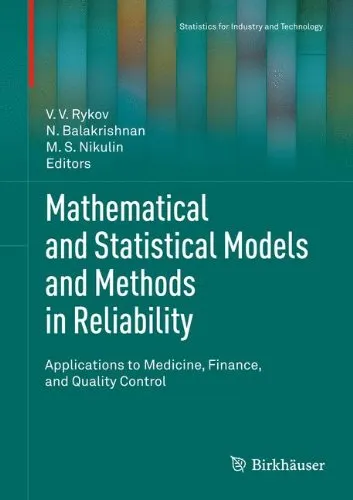
Mathematical and Statistical Models and Methods in Reliability: Applications to Medicine, Finance, and Quality Control
V. S. Koroliuk,N. Limnios (auth.),V.V. Rykov,N. Balakrishnan,M.S. Nikulin (eds.)
English
Beginner
Physics
4.8 / 5
0 reviews
2010
Published
485
pages
126
views
Introduction to "Mathematical and Statistical Models and Methods in Reliability: Applications to Medicine, Finance, and Quality Control" Reliability theory has long been a critical area of study in mathematics and statistics, evolving to address complex problems across v
Before you read
What will you get from this book?
Introduction to "Mathematical and Statistical Models and Methods in Reliability: Applications to Medicine, Finance, and Quality Control"
Reliability theory has long been a critical area of study in mathematics and statistics, evolving to address complex problems across various domains. This book, "Mathematical and Statistical Models and Methods in Reliability: Applications to Medicine, Finance, and Quality Control", brings together modern developments in reliability theory, offering deep insights and practical tools for solving real-world problems across disciplines. This text caters to professionals, academicians, and students by combining mathematics, statistics, applied probability, and computational techniques to deliver actionable insights.
Authored by leading experts, the book’s unique interdisciplinary approach bridges the gap between theoretical developments and their implementation in crucial industries such as healthcare, financial risk management, and quality assurance. It is designed to provide readers with a comprehensive overview of the subject matter while emphasizing practical applications, making it an invaluable resource for practitioners and researchers alike.
Detailed Summary of the Book
Throughout its pages, this book delves deep into the mathematical and statistical frameworks essential for understanding reliability. It begins with introductory material to define concepts such as system reliability, life distributions, and failure rates. From there, it progresses to advanced topics like stochastic processes, survival analysis, and quality control methodologies, tailored for real-world applications.
One of the highlights is its focus on interdisciplinary applications:
- In medicine, the book examines topics such as patient survival analysis, reliability modeling of medical devices, and statistical methods for understanding disease progression.
- In finance, it addresses risk modeling, portfolio optimization under uncertainty, and decision-making frameworks guided by reliability principles and statistics.
- In quality control, the book discusses control charts, failure detection algorithms, and reliability-based design processes used in manufacturing and engineering industries.
The book’s structure combines theoretical rigor with hands-on methodologies. Case studies and examples are weaved throughout, showcasing how the theory is applied to practical challenges and yielding solutions that improve decision-making and process performance.
Key Takeaways
- Broader Understanding: Develop a deeper comprehension of how mathematical and statistical tools can be employed to improve reliability in interdisciplinary settings.
- Applications-Focused Methods: Gain insights into solving real-world problems in medicine, finance, and quality control using reliability modeling and analysis.
- Advanced Concepts Simplified: Master topics such as stochastic models, survival analysis, risk assessment, and maintenance optimization using structured methodologies.
- Practicality: Learn through real-world case studies and numerical examples that illustrate the application of theoretical methods to solve critical issues efficiently.
- Future Directions: Explore modern challenges and innovative tools driving advancements in reliability analysis across industries.
Famous Quotes from the Book
"Reliability is not merely a mathematical concept; it forms the backbone of decision-making in uncertain and high-stakes environments."
"Statistical and mathematical methods in reliability seek to achieve one primary goal—to provide actionable insight into uncertainty."
"From monitoring a patient’s survival to predicting an economic downturn, the power of reliability theory knows no bounds."
Why This Book Matters
Reliability has become an indispensable field that transcends traditional disciplinary boundaries, influencing how we make decisions in high-risk and uncertain settings. This book stands out because it brings together knowledge and techniques from multiple domains while maintaining a seamless approach to teaching and learning. It bridges the gap between theoretical rigor and practical application, offering tools that professionals can implement in real-world scenarios right away.
Furthermore, in today’s rapidly changing environments—be it in healthcare with evolving medical technologies, in finance with volatile markets, or in manufacturing with increasing complexity—the need for robust reliability methodologies has never been more critical. This book equips readers to adapt to these challenges, offering the mathematical and statistical foundations necessary for success. Whether you are a statistician, engineer, healthcare professional, or financial analyst, this book is a cornerstone for advancing your expertise and contributing to your field’s growth.
Ask this book
Your question is answered in the context of this title and author. Each answer uses 2 points.
Sign in to ask the book assistant.
Reader reviews
0 reviews, 4.8 average out of 5
No reviews yet
If you have read this book, help the next reader with your experience.
Write a review
Sign in to publish a review.
Reader questions and answers
Ask a focused question and learn from the community.
Sign in to ask or answer a question.
No questions yet
Be the first to ask a clear, useful question.
What to read next
Related references that continue this learning path.


Modern Computer Vision with PyTorch: A Practical Roadmap From Deep Learning Fundamentals to Advanced Applications and Generative AI, 2nd Edition
V Kishore Ayyadevara,Yeshwanth Reddy
2023
View book