
Book guide and evaluation
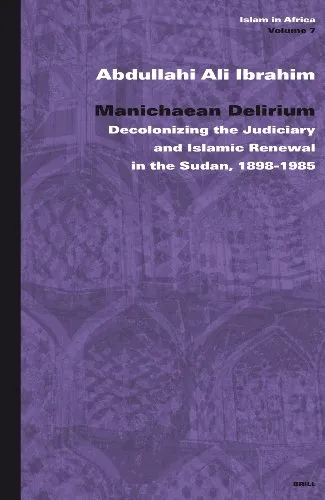
Manichaean Delirium: Decolonizing the Judiciary and Islamic Renewal in Sudan, 1898-1985 (Islam in Africa)
Abdullahi Ali Ibrahim
English
Intermediate
novel
4.3 / 5
0 reviews
2008
Published
448
pages
519
views
Welcome to the world of "Manichaean Delirium: Decolonizing the Judiciary and Islamic Renewal in Sudan, 1898-1985." This groundbreaking work explores the intricate tapestry of Sudanese socio-political life, colonial legacies, and the profound impacts of Islamic renewal
Before you read
What will you get from this book?
Welcome to the world of "Manichaean Delirium: Decolonizing the Judiciary and Islamic Renewal in Sudan, 1898-1985." This groundbreaking work explores the intricate tapestry of Sudanese socio-political life, colonial legacies, and the profound impacts of Islamic renewal on the judiciary system. Authored by 'Abdullahi Ali Ibrahim', the book delves into the historical complexities of Sudan and offers a nuanced narrative of its journey towards decolonization and Islamic rejuvenation.
Detailed Summary of the Book
"Manichaean Delirium" is an in-depth analysis of Sudan's colonial and post-colonial legal systems, documenting the transition from British rule to independent Islamic governance. Spanning the years 1898 to 1985, the book scrutinizes the ideological and practical confrontations that arose as Sudan sought to establish a judiciary in alignment with Islamic principles while disentangling itself from its colonial past. This tension is articulated through a detailed examination of the judicial reforms, political narratives, and the socio-religious dynamics that influenced these transformative years.
Ibrahim investigates the profound duality within Sudanese society — a nation grappling with both the allure of modern statehood and a deep-seated yearning for an Islamic identity. By scrutinizing the legislative evolutions and intellectual discourses, the book uncovers the oscillations between colonial legacies and religious aspirations, highlighting prominent figures and moments that shaped Sudan's judicial landscape. The narrative unfolds the implications of these legal transformations on nationalism, identity, and sovereignty, dramatically capturing the essence of Sudan's "Manichaean Delirium."
Key Takeaways
- The book reveals the intricate balance Sudan strove for in aligning its judiciary system with Islamic law while decolonizing its legal framework.
- It provides an insightful exploration of the intellectual and cultural resistance against colonial legal impositions.
- Through detailed historical analysis, the text underscores the relationship between law, religion, and nationalism in shaping Sudanese identity.
- The narrative underscores the complexity of post-colonial states in redefining governance through the lens of traditional religious values.
Famous Quotes from the Book
"In the heart of Sudan’s legal evolution lay a restless struggle — a yearning to harmonize governance with the spiritual ethos of its people."
"Decolonization was not merely a political endeavor; it was a profound cultural renaissance attempting to reclaim the soul of the Sudanese judiciary."
Why This Book Matters
"Manichaean Delirium" is more than a historical account; it is a critical exploration of the ideological battles that continue to resonate in Sudan and beyond. This book is essential for understanding the complexities of decolonization and the impact of religious revivalism on state institutions. It adds significantly to academic discussions, offering a fresh perspective on how nations navigate legal and cultural identities in the post-colonial era. By examining the Sudanese experience, it informs broader debates on the role of religion in public life and governance, making it a crucial read for scholars, historians, and anyone interested in the dynamics of cultural and legal transformations.
Ask this book
Your question is answered in the context of this title and author. Each answer uses 2 points.
Sign in to ask the book assistant.
Reader reviews
0 reviews, 4.3 average out of 5
No reviews yet
If you have read this book, help the next reader with your experience.
Write a review
Sign in to publish a review.
Reader questions and answers
Ask a focused question and learn from the community.
Sign in to ask or answer a question.
No questions yet
Be the first to ask a clear, useful question.
What to read next
Related references that continue this learning path.

Conrad’s Charlie Marlow: A New Approach to “Heart of Darkness” and Lord Jim
Bernard J. Paris (auth.)
2005
View book