

Book guide and evaluation
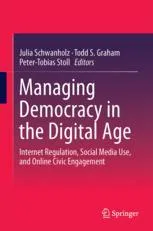
Managing Democracy in the Digital Age: Internet Regulation, Social Media Use, and Online Civic Engagement
Julia Schwanholz,Todd Graham,Peter-Tobias Stoll (eds.)
English
Beginner
Social Media Marketing
4.0 / 5
0 reviews
2018
Published
268
pages
617
views
Introduction Democracy is facing unprecedented challenges in the digital age. The rapid proliferation of internet technologies, social media platforms, and online tools has created new opportunities for civic engagement, information dissemination, and public discourse. However
Before you read
What will you get from this book?
Introduction
Democracy is facing unprecedented challenges in the digital age. The rapid proliferation of internet technologies, social media platforms, and online tools has created new opportunities for civic engagement, information dissemination, and public discourse. However, with these opportunities come significant challenges: misinformation, online abuse, and regulatory dilemmas. In "Managing Democracy in the Digital Age: Internet Regulation, Social Media Use, and Online Civic Engagement," we delve into these critical issues to explore how democracies worldwide are adapting to these transformative changes.
Authored and edited by Julia Schwanholz, Todd Graham, and Peter-Tobias Stoll, this book provides a comprehensive, multidisciplinary examination of how the internet and social media shape modern political processes. By blending theoretical insights and concrete case studies, the work addresses some of the most pressing questions in political science: How should democratic governments regulate online platforms? What is the role of social media in democratic discourse? And most importantly, how can citizens effectively engage in politics in the digital age?
Detailed Summary of the Book
The book is structured to provide a rounded analysis of the complex interplay between democracy and digital technologies. It begins by examining the regulatory landscape, offering a historical perspective on how internet policies have evolved over time. The authors highlight diverse national approaches to managing issues such as fake news, election interference, and online extremism. They argue that regulatory frameworks are not one-size-fits-all; rather, they depend on cultural, political, and technological contexts.
Subsequent chapters scrutinize the impact of social media on political communication. Social media platforms, like Twitter and Facebook, have emerged as significant players in shaping public opinion and facilitating direct interaction between citizens and policymakers. The book discusses both positive and negative aspects of this development, from enabling mass mobilization of movements to amplifying echo chambers and misinformation.
Another core focus of the book is online civic engagement. It explores how technology can empower citizens to play an active role in politics, whether through e-petitions, participatory budgeting apps, or virtual town halls. At the same time, it critically assesses the digital divide and how socioeconomic factors can hinder equal participation in online platforms.
Overall, the book makes it clear that managing democracy in the digital age involves balancing opportunities with significant responsibilities. Stakeholders—from governments to civil society and private corporations—must work together to ensure that democracy not only survives but thrives amid digital transformation.
Key Takeaways
- The internet and social media serve as both enablers and disruptors of democratic practices.
- Regulation of online spaces requires careful attention to protecting free speech while mitigating harm.
- Technology offers immense potential to enhance civic engagement, but barriers such as the digital divide must be addressed to ensure inclusivity.
- Collaborative efforts involving governments, tech companies, and citizens are necessary to safeguard democratic values in the digital age.
- Public trust in digital platforms and institutions must be built and maintained through transparency and accountability.
Famous Quotes from the Book
"Democracy is not just a system of governance; it is an evolving project, and in the digital age, this project faces unparalleled tests."
"The tools that can amplify the voice of the powerless can just as easily be weaponized to mislead, intimidate, and silence."
Why This Book Matters
The importance of this book cannot be overstated. As democracies around the world are tested by digital phenomena such as fake news, cyber interference, and algorithmic influence, it is vital that we understand the mechanisms at play. This book provides both scholars and practitioners with actionable insights into navigating these challenges thoughtfully and responsibly.
Furthermore, the book holds great relevance in raising awareness among citizens, governments, and private entities about their roles in ensuring that digital transformation supports rather than hinders democratic principles. By offering a balanced perspective on both opportunities and pitfalls, it equips readers with the intellectual tools needed to contribute to a more equitable digital future.
In short, "Managing Democracy in the Digital Age" serves as a vital resource for anyone interested in politics, technology, and societal change. Its interdisciplinary approach ensures that readers from diverse fields will find valuable insights within its pages.
Ask this book
Your question is answered in the context of this title and author. Each answer uses 2 points.
Sign in to ask the book assistant.
Reader reviews
0 reviews, 4.0 average out of 5
No reviews yet
If you have read this book, help the next reader with your experience.
Write a review
Sign in to publish a review.
Reader questions and answers
Ask a focused question and learn from the community.
Sign in to ask or answer a question.
No questions yet
Be the first to ask a clear, useful question.
What to read next
Related references that continue this learning path.

Groundswell, Expanded and Revised Edition: Winning in a World Transformed by Social Technologies
Charlene Li,Josh Bernoff
2011
View book
Social Media Marketing: The Next Generation of Business Engagement
Dave Evans,Susan Bratton,Jake McKee
2010
View book