

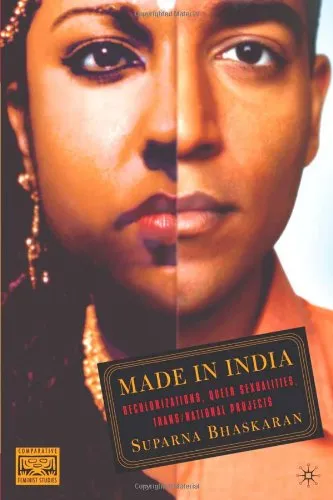
Book guide and evaluation
Made in India: Decolonizations, Queer Sexualities, Trans national Projects (Comparative Feminist Studies)
Suparna Bhaskaran
English
Beginner
Data Science
4.6 / 5
0 reviews
2004
Published
192
pages
217
views
Introduction to "Made in India: Decolonizations, Queer Sexualities, Transnational Projects" "Made in India: Decolonizations, Queer Sexualities, Transnational Projects" is a critically acclaimed work that delves into the intersections of postcolonialism, feminist theory, queern
Before you read
What will you get from this book?
Introduction to "Made in India: Decolonizations, Queer Sexualities, Transnational Projects"
"Made in India: Decolonizations, Queer Sexualities, Transnational Projects" is a critically acclaimed work that delves into the intersections of postcolonialism, feminist theory, queerness, and transnational politics. Authored by Suparna Bhaskaran, this book contributes a nuanced perspective to the field of Comparative Feminist Studies by exploring how identities are shaped, contested, and reconstructed in postcolonial settings, particularly within the Indian socio-cultural and political landscape.
The book weaves together narratives of colonial history, queer activism, globalization, and the lived realities of individuals navigating their identities across borders and historical contexts. By centering South Asia, Bhaskaran challenges Euro-centric frameworks of feminist and queer theory, offering instead a framework rooted in diverse decolonized epistemologies. With theoretical depth and activist insight, "Made in India" is a vital resource for those seeking to understand the complexities of intersectional oppression, forms of resistance, and the road to liberation.
Detailed Summary
"Made in India" is structured around the interconnectedness of identity, sexuality, and decolonization. Bhaskaran begins by examining the historical underpinnings of colonial rule in India and the pervasive legacies of Western dominance that persist in the socio-political structures of modern-day South Asia. She adeptly critiques how colonial ideologies have normalized certain notions of gender and sexuality that continue to marginalize queer bodies in contemporary India.
The book moves beyond academic theory to incorporate personal accounts, oral histories, and grassroots activism. Bhaskaran highlights how queer individuals, particularly those from marginalized socioeconomic backgrounds, negotiate their identities within a framework of both systemic oppression and resilience. Transnational networks of feminist and queer movements are discussed in depth, showcasing both their strengths and the tensions that arise when Western-centric agendas collide with local needs and traditions.
Importantly, the book does not position decolonization, feminism, or queer liberation as linear or monolithic projects. Instead, Bhaskaran insists on embracing the messiness and multiplicity of these struggles. The narrative oscillates between academic critique and storytelling, making it a deeply humanizing text that foregrounds the lived realities of those most impacted by systemic power dynamics.
Key Takeaways
- The lasting impact of colonial rule on gender and sexuality paradigms in India.
- The importance of contextualizing queer movements within local histories and traditions, rather than simply adopting Western frameworks.
- How globalization both enables and limits the possibilities for solidarity within transnational feminist and queer activism.
- A call for intersectional approaches that consider class, caste, gender, and race when addressing issues of decolonization and queer liberation.
- The reclamation of indigenous knowledges and practices as a means to envision alternative futures rooted in justice and equity.
Famous Quotes from the Book
"Decolonization is not merely the undoing of colonial rule—it is the rejection of the ideological frameworks that have quietly governed our minds and bodies for centuries."
"Queerness in the postcolony is not a reflection of a Western category but a rediscovery of ways of being that colonialism sought to erase."
"Global solidarity can only be achieved when we listen to and amplify the voices from the margins, without appropriating or erasing their localness."
Why This Book Matters
"Made in India" is a groundbreaking contribution to fields such as postcolonial theory, gender studies, and queer politics. What sets it apart is its commitment to foregrounding the voices of those most often excluded from academic discourse. Bhaskaran's work bridges the gap between theory and practice, offering an accessible and deeply impactful exploration of some of the most pressing socio-political issues of our time.
The book is particularly relevant in today’s globalized world, where interconnected struggles for equity, justice, and inclusion often collide with nationalist and patriarchal ideologies. By centering South Asian realities and engaging critically with global feminist and queer movements, "Made in India" offers a model for how liberation can be envisioned and enacted in ways that are intersectional, decolonized, and deeply human.
Scholars, activists, and general readers alike will find this book enriching and thought-provoking. It challenges hegemonic narratives, disrupts simplistic binaries, and inspires readers to rethink and reimagine their relationship with identity, power, and liberation.
Ask this book
Your question is answered in the context of this title and author. Each answer uses 2 points.
Sign in to ask the book assistant.
Reader reviews
0 reviews, 4.6 average out of 5
No reviews yet
If you have read this book, help the next reader with your experience.
Write a review
Sign in to publish a review.
Reader questions and answers
Ask a focused question and learn from the community.
Sign in to ask or answer a question.
No questions yet
Be the first to ask a clear, useful question.
What to read next
Related references that continue this learning path.



Modern Computer Vision with PyTorch: A Practical Roadmap From Deep Learning Fundamentals to Advanced Applications and Generative AI, 2nd Edition
V Kishore Ayyadevara,Yeshwanth Reddy
2023
View book