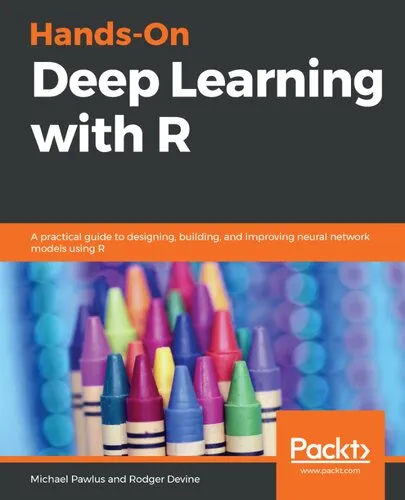
Hands-On Deep Learning with R: A practical guide to designing, building, and improving neural network models using R
Michael Pawlus,Rodger Devine
2020
View book

Book guide and evaluation
Kai-Zhu Huang,Hai-Qin Yang,Irwin King,Michael Lyu
0 reviews
Published
pages
views
Welcome to the detailed introduction of the book "Machine Learning: Modeling Data Locally and Globally (Advanced Topics in Science and Technology in China)". This book, authored by Kai-Zhu Huang, Hai-Qin Yang, Irwin King, and Michael Lyu, provides a comprehensive exploration of
Before you read
Welcome to the detailed introduction of the book "Machine Learning: Modeling Data Locally and Globally (Advanced Topics in Science and Technology in China)". This book, authored by Kai-Zhu Huang, Hai-Qin Yang, Irwin King, and Michael Lyu, provides a comprehensive exploration of machine learning techniques through the lens of local and global modeling paradigms. It bridges advanced theoretical concepts with practical applications, making it a valuable resource for students, researchers, and practitioners looking to deepen their understanding of data modeling in machine learning.
Machine learning has become an essential tool in modern data analysis, enabling systems to learn patterns, adapt to changes, and make predictions autonomously. This book lays out its content methodically, focusing on two complementary perspectives: local and global modeling. Local modeling takes into account narrow regions of the data, emphasizing the importance of locality and neighborhood-based learning. Meanwhile, global modeling targets overarching patterns across the entire dataset.
The book begins with foundational principles of machine learning, offering insights into various algorithms and their relevance in diverse fields such as computer vision, natural language processing, and bioinformatics. It then delves into methods for modeling data locally, covering topics like nearest neighbor methods, kernel-based techniques, and local regression. These approaches are crucial when dealing with complex systems where small-scale interactions play a pivotal role.
In contrast, the global modeling segment examines techniques aimed at understanding the broader structure within data. Methods such as decision trees, support vector machines, and ensemble learning are discussed in-depth, alongside a critical evaluation of their advantages and limitations. By juxtaposing local and global strategies, the book fosters a holistic appreciation of how modern machine learning systems work.
The book concludes with real-world case studies, illustrating how both local and global modeling can be applied to solve complex problems across domains. Whether you are interested in fraud detection, healthcare data analysis, or autonomous systems, this book equips you with the tools to design effective machine learning solutions.
"Machine learning is not just about algorithms; it's a philosophy of understanding data to unlock the hidden mechanisms driving the complexity of our world."
"Local modeling is like walking through a neighborhood to understand its culture, whereas global modeling offers a bird's-eye view of the city's structure."
"The art of machine learning lies in striking the right balance between the local and the global. It is through this harmony that truly intelligent systems emerge."
"A machine learning practitioner is both a scientist and an artist, weaving together data and algorithms to create systems that can think, adapt, and predict."
In the rapidly evolving field of machine learning, the importance of understanding both local and global modeling cannot be overstated. This book provides readers with the theoretical depth and practical skills needed to tackle diverse challenges in data science. By breaking complex concepts into digestible chapters, it serves as a bridge for those transitioning from academic study to real-world problem-solving.
Furthermore, the focus on local and global perspectives offers a unique approach to machine learning that is not commonly covered in other texts. As industries increasingly rely on machine learning to make informed decisions, this book helps readers build the expertise required to design solutions that are precise, scalable, and adaptable. It encourages a balanced way of thinking, pushing practitioners to consider both individual data points and the larger context during model development.
Whether you are just beginning your journey in machine learning or looking to expand your knowledge, "Machine Learning: Modeling Data Locally and Globally" is an indispensable guide. It imparts not only technical proficiency but also the philosophical underpinnings that drive innovation in this field.
In essence, this book matters because it equips readers to solve real-world problems in smarter, more efficient ways—a critical capability in an era dominated by data-driven decision-making.
Your question is answered in the context of this title and author. Each answer uses 2 points.
0 reviews, 4.5 average out of 5
Sign in to publish a review.
Ask a focused question and learn from the community.
Related references that continue this learning path.
Michael Pawlus,Rodger Devine