Loading
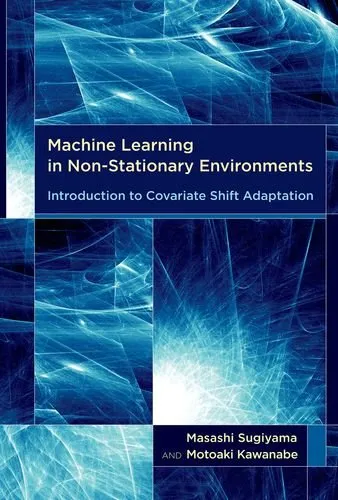
Cover of Machine Learning in Non-Stationary Environments: Introduction to Covariate Shift Adaptation

Book guide and evaluation

Machine Learning in Non-Stationary Environments: Introduction to Covariate Shift Adaptation

Masashi Sugiyama,Motoaki Kawanabe

English Beginner Machine Learning
4.7 / 5

0 reviews

2012

Published

263

pages

516

views

As the power of computing has grown over the past few decades, the field of machine learning has advanced rapidly in both theory and practice. Machine learning methods are usually based on the assumption that the data generation mechanism does not change over time. Yet real-world

Before you read

What will you get from this book?

As the power of computing has grown over the past few decades, the field of machine learning has advanced rapidly in both theory and practice. Machine learning methods are usually based on the assumption that the data generation mechanism does not change over time. Yet real-world applications of machine learning, including image recognition, natural language processing, speech recognition, robot control, and bioinformatics, often violate this common assumption. Dealing with non-stationarity is one of modern machine learning's greatest challenges. This book focuses on a specific non-stationary environment known as covariate shift, in which the distributions of inputs (queries) change but the conditional distribution of outputs (answers) is unchanged, and presents machine learning theory, algorithms, and applications to overcome this variety of non-stationarity. After reviewing the state-of-the-art research in the field, the authors discuss topics that include learning under covariate shift, model selection, importance estimation, and active learning. They describe such real world applications of covariate shift adaption as brain-computer interface, speaker identification, and age prediction from facial images. With this book, they aim to encourage future research in machine learning, statistics, and engineering that strives to create truly autonomous learning machines able to learn under non-stationarity.

Ask this book

Your question is answered in the context of this title and author. Each answer uses 2 points.

Sign in to ask the book assistant.

Reader reviews

0 reviews, 4.7 average out of 5

No reviews yet

If you have read this book, help the next reader with your experience.

Write a review

Sign in to publish a review.

Reader questions and answers

Ask a focused question and learn from the community.

Sign in to ask or answer a question.

No questions yet

Be the first to ask a clear, useful question.