Artificial Intelligence, Machine Learning and Blockchain in Quantum Satellite, Drone and Network
Thiruselvan Subramanian,Archana Dhyani,Adarsh Kumar,Sukhpal Singh Gill
2022
View book
Book guide and evaluation
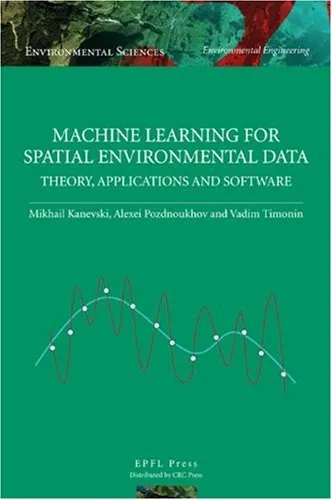
Mikhail Kanevski,Vadim Timonin,Alexi Pozdnukhov
0 reviews
Published
pages
views
Introduction to Machine Learning for Spatial Environmental Data Exploring the Intersection of Machine Learning and Environmental Science In recent years, the exponential growth of spatial data has opened up new avenues for understanding complex environmental systems. Machin
Before you read
Exploring the Intersection of Machine Learning and Environmental Science
In recent years, the exponential growth of spatial data has opened up new avenues for understanding complex environmental systems. Machine Learning for Spatial Environmental Data: Theory, Applications, and Software presents a compelling integration of up-to-date machine learning techniques with environmental sciences, offering insights into the application of data-driven methodologies in the spatial domain. Authored by Mikhail Kanevski, Vadim Timonin, and Alexi Pozdnukhov, this book provides a comprehensive approach for harnessing the power of machine learning to address environmental challenges.
The book is meticulously organized into several sections guiding readers through foundational theory, sophisticated application strategies, and practical software tools tailored for spatial environmental data. In the initial chapters, readers are introduced to the fundamental concepts of machine learning and their relevance to spatial data. The authors elucidate key techniques including regression, classification, clustering, and dimensionality reduction, applying them to geographical information systems (GIS) and remote sensing data.
As the book progresses, it delves into advanced discussions on spatial data characteristics, such as spatial autocorrelation, nonstationarity, and heterogeneity. These discussions are complemented by real-world case studies illustrating the application of machine learning algorithms to environmental monitoring, disaster risk management, and natural resource exploration. The authors provide practical guidance on leveraging open-source software and libraries, enabling practitioners to implement these techniques robustly and efficiently.
“A profound understanding of spatial dimensions transforms how we interpret environmental phenomena and address global environmental challenges.”
“Machine learning, with its capacity to model complex patterns and relationships, serves as a cornerstone for advancing our knowledge of the environment.”
As environmental concerns increasingly take center stage globally, the demand for innovative solutions becomes more pressing. This book stands at the forefront of educational resources, equipping researchers, practitioners, and students with the knowledge to employ machine learning in spatial contexts effectively. By providing a blend of theory, practical applications, and software tools, the authors ensure that readers can directly impact environmental decision-making processes.
Moreover, the book fosters an interdisciplinary mindset, encouraging collaboration between computer scientists, geographers, environmentalists, and policy-makers. This approach is crucial for tackling multi-faceted issues such as climate change, resource management, and disaster mitigation. The comprehensive nature of the book makes it an invaluable asset not only for those in academia but also for professionals engaged in industry or governmental roles responsible for implementing environmental policies.
Your question is answered in the context of this title and author. Each answer uses 2 points.
0 reviews, 4.3 average out of 5
Sign in to publish a review.
Ask a focused question and learn from the community.
Related references that continue this learning path.
Thiruselvan Subramanian,Archana Dhyani,Adarsh Kumar,Sukhpal Singh Gill
Sebastian Raschka,Vahid Mirjalili