
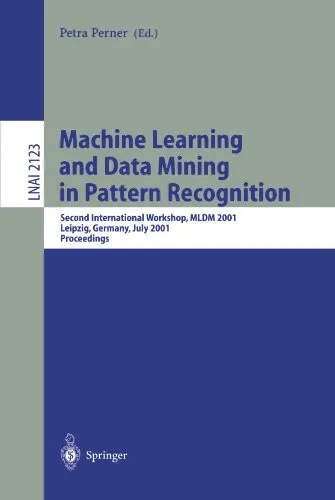
Machine Learning and Data Mining in Pattern Recognition: Second International Workshop, MLDM 2001 Leipzig, Germany, July 25–27, 2001 Proceedings
Ari Visa (auth.),Petra Perner (eds.)
2001
View book

Book guide and evaluation
Rakesh Agrawal (auth.),Dimitrios Gunopulos,Thomas Hofmann,Donato Malerba,Michalis Vazirgiannis (eds.)
0 reviews
Published
pages
views
Introduction The book "Machine Learning and Knowledge Discovery in Databases" is a comprehensive compilation of cutting-edge research contributions presented at the European Conference on Machine Learning and Principles and Practice of Knowledge Discovery in Databa
Before you read
The book "Machine Learning and Knowledge Discovery in Databases" is a comprehensive compilation of cutting-edge research contributions presented at the European Conference on Machine Learning and Principles and Practice of Knowledge Discovery in Databases (ECML PKDD 2011). Held in Athens, Greece, from September 5 to September 9, 2011, this conference brought together some of the brightest minds in the fields of machine learning (ML) and data mining to address pressing challenges and explore novel methodologies. This first part of the proceedings serves as a detailed exploration of innovative ideas, algorithmic advancements, and practical insights that are reshaping the technological landscape.
This volume is part of the Lecture Notes in Computer Science series and serves as an invaluable resource for researchers, academicians, and practitioners interested in ML and knowledge discovery. It contains peer-reviewed papers that span a wide array of topics, from theoretical approaches to real-world applications, reflecting the diversity and dynamism in the field of data-driven discovery.
“Machine Learning and Knowledge Discovery in Databases” encapsulates 54 carefully selected papers that delve into fundamental and emerging topics in machine learning and data mining. These papers are divided across various themes that include supervised and unsupervised learning, graph and network analysis, feature engineering, online learning paradigms, and domain-specific applications.
Key focus areas include but are not limited to improving learning models' scalability, efficiency, and interpretability, which are essential for handling the massive data generated in the modern era. Researchers also focus on algorithms for handling noisy, imbalanced, or incomplete datasets—a common challenge faced in real-world data exploration. Innovative papers on ensemble methods, active learning, and semi-supervised learning expand the boundary of what is achievable in practical implementations.
The volume also emphasizes the intersection of machine learning with other disciplines, such as natural language processing, bioinformatics, social network analysis, and personalized recommendation systems. Papers demonstrating practical applications illustrate how these methods can be deployed for actionable intelligence in industries like healthcare, finance, and e-commerce.
"Machine learning is not just about algorithms; it's about leveraging data to illuminate patterns and drive actionable insights."
"In real-world applications, the true challenge lies not in building models, but in ensuring that they are interpretable, efficient, and aligned with domain knowledge."
"Data-driven discovery represents the confluence of human intuition and computational power, unlocking the potential for groundbreaking innovation."
This book is an essential read for anyone passionate about machine learning and knowledge discovery. With its collection of groundbreaking research, it provides a deep dive into the methodologies and practices driving this field forward. Its importance lies in the breadth of topics it covers and the practical implications of its findings.
Modern organizations thrive on data. Whether it is personalized recommendations, optimizing supply chains, or improving medical diagnoses, the importance of effective data-driven decision-making cannot be overstated. This book provides a foundation for understanding the mechanisms and techniques needed to process and analyze vast quantities of information, offering both seasoned professionals and budding researchers the tools they need to succeed.
Moreover, the insights and methodologies discussed have significant societal relevance—they enable solutions for some of our greatest global challenges, from healthcare to climate science. By summarizing the collective expertise of a vibrant community of scholars, this book serves as both a snapshot of the state-of-the-art in 2011 and a forward-looking guide to shaping tomorrow’s innovations.
Your question is answered in the context of this title and author. Each answer uses 2 points.
0 reviews, 4.5 average out of 5
Sign in to publish a review.
Ask a focused question and learn from the community.
Related references that continue this learning path.
Ari Visa (auth.),Petra Perner (eds.)

Dennis Leman,Ad Feelders,Arno Knobbe (auth.),Walter Daelemans,Bart Goethals,Katharina Morik (eds.)


Johannes Fürnkranz,Tobias Scheffer,Myra Spiliopoulou