Loading
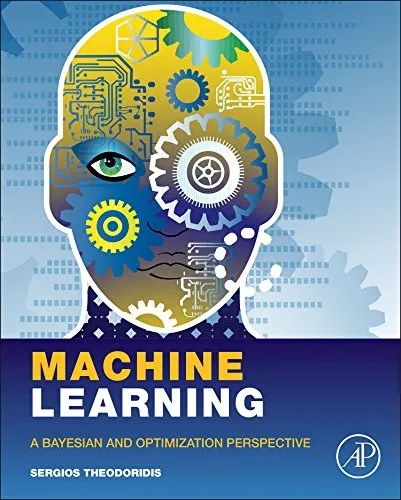
Cover of Machine Learning: A Bayesian and Optimization Perspective
English Beginner Machine Learning

Machine Learning: A Bayesian and Optimization Perspective

Sergios Theodoridis

Sergios Theodoridis

4.9 / 5

0 reviews

2015

Published

1072

pages

329

views

This tutorial text gives a unifying perspective on machine learning by covering both probabilistic and deterministic approaches -which are based on optimization techniques – together with the Bayesian inference approach, whose essence lies in the use of a hierarchy of probabilist

About this book

This tutorial text gives a unifying perspective on machine learning by covering both probabilistic and deterministic approaches -which are based on optimization techniques – together with the Bayesian inference approach, whose essence lies in the use of a hierarchy of probabilistic models. The book presents the major machine learning methods as they have been developed in different disciplines, such as statistics, statistical and adaptive signal processing and computer science. Focusing on the physical reasoning behind the mathematics, all the various methods and techniques are explained in depth, supported by examples and problems, giving an invaluable resource to the student and researcher for understanding and applying machine learning concepts. The book builds carefully from the basic classical methods  to  the most recent trends, with chapters written to be as self-contained as possible, making the text suitable for  different courses: pattern recognition, statistical/adaptive signal processing, statistical/Bayesian learning, as well as short courses on sparse modeling, deep learning, and probabilistic graphical models.All major classical techniques: Mean/Least-Squares regression and filtering, Kalman filtering, stochastic approximation and online learning, Bayesian classification, decision trees, logistic regression and boosting methods.The latest trends: Sparsity, convex analysis and optimization, online distributed algorithms, learning in RKH spaces, Bayesian inference, graphical and hidden Markov models, particle filtering, deep learning, dictionary learning and latent variables modeling.Case studies - protein folding prediction, optical character recognition, text authorship identification, fMRI data analysis, change point detection, hyperspectral image unmixing, target localization, channel equalization and echo cancellation, show how the theory can be applied.MATLAB code for all the main algorithms are available on an accompanying website, enabling the reader to experiment with the code.

Ask this book

Your question is answered in the context of this title and author. Each answer uses 2 points.

Sign in to ask the book assistant.

Reader reviews

0 reviews · 4.9 average out of 5

No reviews yet

If you have read this book, help the next reader with your experience.

Write a review

Sign in to publish a review.

Reader questions and answers

Ask a focused question and learn from the community.

Sign in to ask or answer a question.

No questions yet

Be the first to ask a clear, useful question.

Related references that continue this learning path.