Python for DevOps: Learn Ruthlessly Effective Automation
Noah Gift,Kennedy Behrman,Alfredo Deza,Grig Gheorghiu
2020
View book
Book guide and evaluation
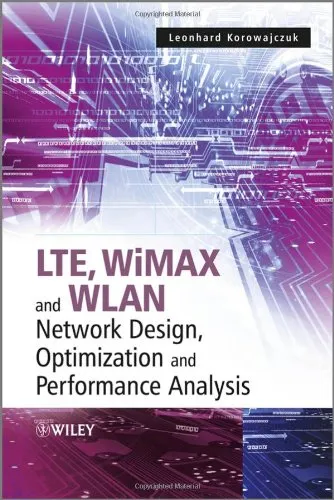
Leonhard Korowajczuk
0 reviews
Published
pages
views
Introduction to LTE, WiMAX and WLAN Network Design, Optimization and Performance Analysis Welcome to a comprehensive exploration of the world of modern wireless communications. This book, "LTE, WiMAX and WLAN Network Design, Optimization and Performance Analysis," serves as an
Before you read
Welcome to a comprehensive exploration of the world of modern wireless communications. This book, "LTE, WiMAX and WLAN Network Design, Optimization and Performance Analysis," serves as an in-depth resource for both beginners and seasoned professionals seeking to deepen their understanding of these pivotal technologies.
As communication technologies evolve, understanding their underlying principles, design, and optimization becomes increasingly crucial. This book provides a detailed examination of LTE (Long-Term Evolution), WiMAX (Worldwide Interoperability for Microwave Access), and WLAN (Wireless Local Area Network) technologies. The foundation of this exploration rests on explaining the core concepts, architectures, and technical specifications that define these systems.
The book begins by tracing the historical progressions of wireless communication networks, offering insights into the evolution of data transmission from simple cellular systems to complex broadband structures. It delves into the technical depths of LTE, describing its superior channel architectures, modulation techniques, and capabilities for handling high data rates and low latency. WiMAX is explored as a versatile technology offering diverse applications in metropolitan and rural broadband access. WLAN is analyzed in terms of its deployments, benefits in local networks, and role in bridging the last-mile connectivity gap.
Design considerations are critically evaluated, including discussions on spectrum allocations, network topologies, and equipment requirements. The book progresses into optimization techniques, focusing on resource allocation, interference management, and quality of service enhancements. Lastly, performance metrics are dissected, teaching the reader how to assess and improve network capabilities effectively.
"Understanding the intricacies of network design is not just about bandwidth and speed—it's about anticipating future demands and crafting systems that are both reliable and scalable."
"Optimization is the art of making choices intelligently to achieve the utmost efficiency and effectiveness in a network's operations."
In an era defined by connectivity and constant technological innovation, wireless communication serves as the backbone of digital interaction. The book "LTE, WiMAX and WLAN Network Design, Optimization and Performance Analysis" addresses the critical need for well-informed engineers, designers, and operators who can delve into the technical complexities of these networks with confidence.
By bridging theoretical frameworks with real-world applications, this book provides invaluable insights for those involved in telecommunication, whether in academic settings or as part of professional development. It equips readers with the knowledge to contribute to the ongoing improvements and adaptations necessary for modern networks to meet growing demands.
This book is not only a technical guide but also a testament to the transformative power of innovation in communications, making it a must-read for anyone passionate about the future of connectivity.
Your question is answered in the context of this title and author. Each answer uses 2 points.
0 reviews, 4.4 average out of 5
Sign in to publish a review.
Ask a focused question and learn from the community.
Related references that continue this learning path.
Noah Gift,Kennedy Behrman,Alfredo Deza,Grig Gheorghiu