Structural Information and Communication Complexity: 16th International Colloquium, SIROCCO 2009, Piran, Slovenia, May 25-27, 2009, Revised Selected Papers
Israel Cidon (auth.),Shay Kutten,Janez Žerovnik (eds.)
2010
View book
Book guide and evaluation
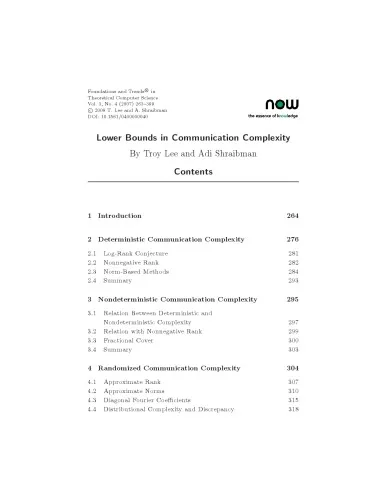
Troy Lee,Adi Shraibman
0 reviews
Published
pages
views
Introduction to "Lower Bounds in Communication Complexity" Dive into the intricate world of communication complexity with our thorough exploration of foundational lower bounds in this crucial area of theoretical computer science. This book offers a comprehensive journey fo
Before you read
Dive into the intricate world of communication complexity with our thorough exploration of foundational lower bounds in this crucial area of theoretical computer science. This book offers a comprehensive journey for both students and seasoned researchers eager to understand the depths of this specialized field.
Our book, "Lower Bounds in Communication Complexity," is a meticulous examination of the fundamental tools and methods used to analyze the communication lessened by distributed systems during computations. In the realm of communication complexity, we study the minimum amount of information exchange necessary for performing computational tasks—or, more precisely, solving problems distributed among multiple parties.
Structured across various sections, the book begins by introducing the reader to the basic concepts and definitions of communication complexity. We continue with a review of both the deterministic and non-deterministic complexity of protocols before moving into more specialized territory, such as randomized and quantum communication complexity.
Focusing on lower bounds, we delve into key techniques such as the Rectangle Method, Yao’s Principle, and Discrepancy. Advanced topics include reductions, fooling sets, and information complexity. We aim to not only present the theoretical framework but also showcase applications of these theories in diverse fields like data streams, distributed computing, and gene regulatory networks.
Throughout the book, readers will gain:
"Understanding the limits of communication is essential to pushing the boundaries of what distributed systems can achieve." - Troy Lee & Adi Shraibman
"Lower bounds in communication serve not just as restrictions but as guides that show us how to design more efficient algorithms." - Troy Lee & Adi Shraibman
In an era dominated by data and networked technologies, the inefficiencies in communication can become the bottleneck in systems performance. With the increasing complexity and distribution of computing tasks, understanding communication limitations is more important than ever. This book serves as a crucial resource for those looking to break new ground in computer science by providing them with the necessary tools to understand and optimize communication costs.
Armed with the knowledge contained within this book, computer scientists, engineers, and researchers are better positioned to develop cutting-edge solutions that require less information exchange, thus expanding capabilities while reducing costs. Whether it's cloud computing, machine learning, or internet protocols, the principles and lower bounds presented in this book are of timeless relevance.
Moreover, this work stands as a testament to the continuing need for rigorous theoretical foundations in advancing applied technology, reminding us that behind every innovative technological advancement is an essential layer of theory predicated on understanding the limits of what can be communicated.
Your question is answered in the context of this title and author. Each answer uses 2 points.
0 reviews, 4.6 average out of 5
Sign in to publish a review.
Ask a focused question and learn from the community.
Related references that continue this learning path.
Israel Cidon (auth.),Shay Kutten,Janez Žerovnik (eds.)
William Stallings