

Book guide and evaluation
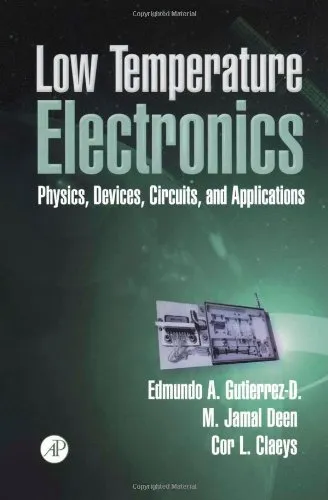
Low Temperature Electronics: Physics, Devices, Circuits, and Applications
Edmundo A. Gutierrez-D,Jamal Deen,Cor Claeys
English
Beginner
Engineering
4.7 / 5
0 reviews
2000
Published
985
pages
194
views
Introduction to "Low Temperature Electronics: Physics, Devices, Circuits, and Applications" The book "Low Temperature Electronics: Physics, Devices, Circuits, and Applications" is a pioneering work aimed at uncovering the fascinating and intricate landscape of electronics
Before you read
What will you get from this book?
Introduction to "Low Temperature Electronics: Physics, Devices, Circuits, and Applications"
The book "Low Temperature Electronics: Physics, Devices, Circuits, and Applications" is a pioneering work aimed at uncovering the fascinating and intricate landscape of electronics at low temperatures. Authored by Edmundo A. Gutierrez-D, Jamal Deen, and Cor Claeys, this authoritative text serves as a comprehensive resource for researchers, engineers, and students delving into one of the most compelling subfields of electronics. From fundamental physics to cutting-edge applications, the book equips readers with extensive insights, connecting theoretical knowledge with practical implementations.
As technology continues to demand greater processing power, efficiency, and reliability, the use of low-temperature environments for electronic devices holds immense promise. This book addresses those opportunities by combining a detailed study of the fundamental physics of semiconductors and related materials with the design and operation of circuits specifically optimized for low-temperature conditions. It is an essential guide for understanding the challenges and unlocking the potential of electronics operating in this unique regime.
Detailed Summary of the Book
The book begins by delving into the foundational physics underpinning low-temperature electronics. It explores the behavior of semiconductor materials and devices when exposed to temperatures significantly below room temperature. These conditions result in phenomena not typically observable in standard environments, such as reduced thermal noise and altered carrier mobility, which are discussed in depth to illustrate the opportunities they create for electronic performance.
Following this, the text transitions into addressing how traditional devices, such as diodes, transistors, and MOSFETs, behave when subjected to low temperatures. Their operational characteristics and unique challenges are meticulously analyzed, providing readers with a clear view of how device performance can be optimized.
On the applications side, the book explores how low-temperature environments are exploited in advanced computing systems, space technology, and high-performance electronics. Key topics include precision analog circuits, cryogenic memories, and low-power logic designs vital for resource-constrained and high-stability applications. From the practical perspective, the book assesses methods for ensuring reliable performance, thermal management, and the interplay of low-temperature electronics with superconducting circuits.
Key Takeaways
- A deep dive into the physics of semiconductors at cryogenic temperatures, providing a scientific foundation for understanding low-temperature electronics.
- Detailed discussions on the behavior and optimization of electronic devices such as MOSFETs, BJTs, and CMOS circuits at low temperatures.
- Exclusive insights into the applications of low-temperature electronics in space missions, quantum computing, and superconducting technologies.
- Solutions to practical challenges such as device reliability, material stress, and the design of circuits operating in harsh cryogenic environments.
- A connection between theoretical advancements and practical implementation in futuristic electronic applications.
Famous Quotes from the Book
"As we lower the temperature, we uncover the latent potential of materials, enabling breakthroughs that redefine the boundaries of electronic performance."
"Low-temperature electronics present not just engineering challenges, but an opportunity to glimpse the fundamental mechanics of nature at play."
"Precision, efficiency, and innovation culminate at the intersection of advanced physics and practical engineering—this is the spirit of cryo-electronics."
Why This Book Matters
In an era where technological advancements are paramount, "Low Temperature Electronics" stands out as a cornerstone text that bridges the gap between theoretical physics and real-world engineering applications. It addresses the growing need for efficient, high-performance, and reliable electronics in extreme operating conditions. This is particularly vital for sectors like aerospace, telecommunications, medical technology, and quantum computing, where low temperatures are either designed or naturally occurring.
By offering a holistic understanding of low-temperature electronics, this book paves the way for innovation and fosters a new generation of researchers and professionals equipped to tackle imminent technical challenges. The collective expertise of Edmundo A. Gutierrez-D, Jamal Deen, and Cor Claeys ensures that this work not only reflects current knowledge but also anticipates future trends, making it an invaluable asset for anyone invested in the future of electronics.
Whether you are a seasoned researcher, practicing engineer, or a student venturing into this exciting field, this book provides the tools and inspiration to excel. Its significance lies not only in its technical depth but also in its ability to educate and motivate readers to contribute meaningfully to the development of next-generation electronic systems.
Ask this book
Your question is answered in the context of this title and author. Each answer uses 2 points.
Sign in to ask the book assistant.
Reader reviews
0 reviews, 4.7 average out of 5
No reviews yet
If you have read this book, help the next reader with your experience.
Write a review
Sign in to publish a review.
Reader questions and answers
Ask a focused question and learn from the community.
Sign in to ask or answer a question.
No questions yet
Be the first to ask a clear, useful question.
What to read next
Related references that continue this learning path.


Modern Computer Vision with PyTorch: A Practical Roadmap From Deep Learning Fundamentals to Advanced Applications and Generative AI, 2nd Edition
V Kishore Ayyadevara,Yeshwanth Reddy
2023
View book