
Book guide and evaluation
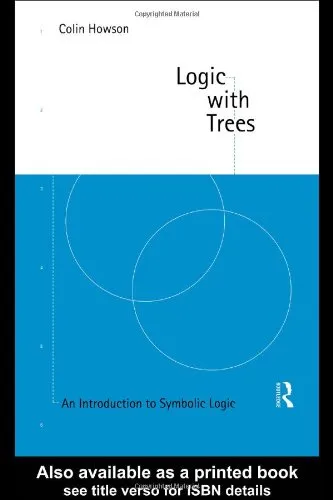
Logic with Trees: An Introduction to Symbolic Logic
Colin Howson
English
Beginner
Mathematics
3.5 / 5
0 reviews
1997
Published
210
pages
390
views
Introduction to "Logic with Trees: An Introduction to Symbolic Logic" "Logic with Trees: An Introduction to Symbolic Logic" serves as a comprehensive guide for students and enthusiasts eager to delve into the intricate world of symbolic logic. Writt
Before you read
What will you get from this book?
Introduction to "Logic with Trees: An Introduction to Symbolic Logic"
"Logic with Trees: An Introduction to Symbolic Logic" serves as a comprehensive guide for students and enthusiasts eager to delve into the intricate world of symbolic logic. Written by Colin Howson, this book simplifies complex concepts through a novel approach using the method of tableaux or truth-trees, which offers a more intuitive understanding of logical principles. This method aids in the progression from elementary to advanced levels of logic, making it an ideal choice for both beginners and those looking to solidify their foundational knowledge.
Detailed Summary of the Book
The book begins by laying out the basic elements of logical theory, providing readers with a foundation they can build upon. By using truth-trees, Howson transcends the traditional methodologies that often intimidate new learners. The initial chapters cover propositional logic, where readers engage with logical operators and truth-functional propositions, developing their skills through strategically designed exercises.
As the chapters progress, the book delves into predicate logic. This section introduces quantifiers and predicates in a manner that underscores their practical implications, connecting abstract concepts with real-world applications. Howson's emphasis on the method of tableaux stands out, as it is employed not just to test logical consistency or validity, but as a tool to cultivate a deeper understanding of abstract reasoning and proof methods.
The latter part of the book addresses advanced topics such as modal logic, offering insights into necessity and possibility, and the nuances that come with these modal operators. By the end of the book, readers gain not only a technical understanding of logical systems but also an appreciation for the philosophical questions they address, positioning logic as both a mathematical and a philosophical discipline.
Key Takeaways
- Comprehensive coverage of propositional and predicate logic with a focus on truth-trees.
- A gradual build-up from basic to advanced logic topics, fostering deep understanding.
- Practical exercises designed to reinforce formal logical concepts.
- Introduction to modal logic, expanding on necessity and possibility.
- An insight into the philosophical implications of logic.
Famous Quotes from the Book
“Logic is not a body of doctrine, but a mirror of the world. Logic is transcendental.”
“True logic goes beyond mere mechanical calculation; it weaves the fundamental fabric of language and thought.”
Why This Book Matters
"Logic with Trees: An Introduction to Symbolic Logic" stands out in the field of logical studies for its accessible approach that demystifies the subject. The book's strength lies in its ability to capture the curiosity of the reader, encouraging a deeper exploration into logical theory and applications. Howson's method of truth-trees simplifies abstract concepts, making them accessible to individuals who might otherwise be overwhelmed by traditional approaches.
The book is not just an educational tool but also a catalyst for critical thinking. It influences readers to question and explore beyond the written text, engaging with logic as a living, breathing discipline. This work matters because it bridges the gap between logic as a formal study and its real-world implications, offering insights that are both intellectual and practical.
Ask this book
Your question is answered in the context of this title and author. Each answer uses 2 points.
Sign in to ask the book assistant.
Reader reviews
0 reviews, 3.5 average out of 5
No reviews yet
If you have read this book, help the next reader with your experience.
Write a review
Sign in to publish a review.
Reader questions and answers
Ask a focused question and learn from the community.
Sign in to ask or answer a question.
No questions yet
Be the first to ask a clear, useful question.
What to read next
Related references that continue this learning path.


Modern Computer Vision with PyTorch: A Practical Roadmap From Deep Learning Fundamentals to Advanced Applications and Generative AI, 2nd Edition
V Kishore Ayyadevara,Yeshwanth Reddy
2023
View book