

Book guide and evaluation
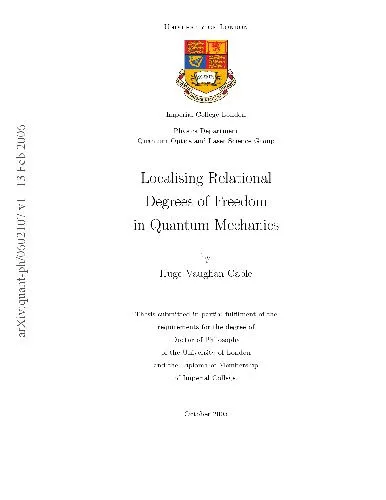
Localising Relational Degrees of Freedom in Quantum Mechanics. Thesis
H. cable
English
Beginner
Art
4.4 / 5
0 reviews
-
Published
130
pages
172
views
Introduction to "Localising Relational Degrees of Freedom in Quantum Mechanics" "Localising Relational Degrees of Freedom in Quantum Mechanics" is a profound exploration of foundational questions in quantum theory, specifically focusing on how relational
Before you read
What will you get from this book?
Introduction to "Localising Relational Degrees of Freedom in Quantum Mechanics"
"Localising Relational Degrees of Freedom in Quantum Mechanics" is a profound exploration of foundational questions in quantum theory, specifically focusing on how relational systems of particles and fields can be understood and described in a localised context. This thesis dives deeply into the conceptual framework of quantum mechanics, recasting traditional interpretations through a relational lens to address the challenges of localising degrees of freedom inherent to quantum systems.
This book is designed to serve researchers, students, and enthusiasts of quantum mechanics who are curious about the interplay between locality and relativity in quantum frameworks. With rigorous mathematical derivations and thought-provoking arguments, it opens the door to understanding how relational degrees of freedom can shape the way we think about the structure of quantum systems. By embedding locality within the context of relationalism, this thesis examines how independent subsystems can still remain connected through the intricate network of quantum relationships.
A Detailed Summary of the Book
"Localising Relational Degrees of Freedom in Quantum Mechanics" is split into several key sections, each building upon one another to create a cohesive understanding of the topic. The thesis begins by reviewing the conventional definitions of quantum degrees of freedom and the challenges posed by non-locality and entanglement. These ideas are pivotal to quantum mechanics but often lead to interpretational difficulties when trying to reconcile them with the locality principle in relativity.
The book then shifts to exploring relational degrees of freedom, where the state of one system is not defined in isolation, but rather through its relationships with other systems. This relational perspective offers a fresh approach to addressing the problem of localising information within a system of entangled particles.
After laying down the mathematical and theoretical groundwork, the thesis examines key case studies and applications of these ideas, including quantum field theories and non-classical spacetime descriptions. Several chapters are devoted to disentangling the nuanced interplay between relational observables, gauge symmetries, and physical information within specific quantum systems. The thesis concludes with reflections on the philosophical implications of quantum relationalism and suggestions for experimental tests that could shed light on these concepts.
Key Takeaways
- A deep dive into the challenges of defining and localising relational degrees of freedom within quantum systems.
- A novel framework that bridges relational interpretations and locality principles in quantum mechanics.
- Insights into the role of gauge symmetries and relational observables in understanding quantum states.
- Practical case studies that apply the relational framework to complex quantum systems.
- Philosophical implications of adopting relationalism as a foundation for interpreting quantum reality.
Famous Quotes from the Book
"The essence of quantum mechanics lies not in the state of isolated systems, but in the relationships between them, where locality emerges as a secondary principle from the fabric of entangled connections."
"Relational degrees of freedom are not mere abstractions—they are the building blocks of a truly localised reality in the quantum realm."
"Understanding locality in a quantum framework requires us to redefine what it means to ‘be somewhere’—a question that can only be answered relationally."
Why This Book Matters
In a time when quantum mechanics stands at the forefront of scientific innovation, addressing its foundational questions remains both a challenge and an opportunity. "Localising Relational Degrees of Freedom in Quantum Mechanics" seeks to push the boundaries of how we interpret quantum systems, addressing one of the most enigmatic aspects of the theory: the tension between locality and relationalism.
This book matters because it transcends the boundaries of physics, philosophy, and mathematics. It not only advances theoretical research in quantum mechanics but also lays the groundwork for potential breakthroughs in quantum computing, quantum field theory, and fundamental physics. By providing a detailed and rigorous analysis of relational degrees of freedom, this thesis offers a new perspective that could help answer some of the long-standing questions about the nature of quantum reality.
Ask this book
Your question is answered in the context of this title and author. Each answer uses 2 points.
Sign in to ask the book assistant.
Reader reviews
0 reviews, 4.4 average out of 5
No reviews yet
If you have read this book, help the next reader with your experience.
Write a review
Sign in to publish a review.
Reader questions and answers
Ask a focused question and learn from the community.
Sign in to ask or answer a question.
No questions yet
Be the first to ask a clear, useful question.
What to read next
Related references that continue this learning path.


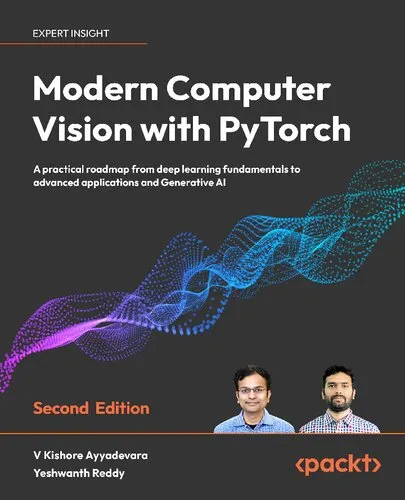
Modern Computer Vision with PyTorch: A Practical Roadmap From Deep Learning Fundamentals to Advanced Applications and Generative AI, 2nd Edition
V Kishore Ayyadevara,Yeshwanth Reddy
2023
View book