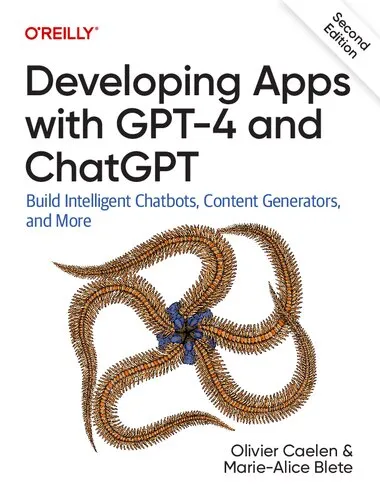
Developing Apps with GPT-4 and ChatGPT: Build Intelligent Chatbots, Content Generators, and More, 2nd Edition
Olivier Caelen,Marie-Alice Blete
2024
View book
Book guide and evaluation
Code, Et Tu
0 reviews
Published
pages
views
LLM, Transformer, RAG AI: Mastering Large Language Models, Transformer Models, and Retrieval-Augmented Generation (RAG) Technology Artificial Intelligence Architecture, Machine Learning Innovation Comprehensive guide to LLM, Transformer, RAG AI for advanced AI practitioners.
Before you read
In an era where artificial intelligence is reshaping industries, research practices, and everyday life, LLM, Transformer, RAG AI: Mastering Large Language Models, Transformer Models, and Retrieval-Augmented Generation (RAG) Technology stands as an authoritative, in-depth resource for understanding the mechanisms and applications driving today’s most sophisticated AI systems. This book provides readers with a finely tuned blend of theoretical foundations, architectural breakdowns, and practical insights into the technologies that define modern natural language processing (NLP).
From the core functionality of large language models (LLMs) to the intricacies of transformer architectures, readers will find careful explanations reinforced by visual schematics and case studies. The text dedicates substantial attention to Retrieval-Augmented Generation (RAG), detailing how integrating retrieval mechanisms into generative models dramatically improves factual accuracy and contextual depth.
Whether the reader is an academic exploring conceptual proof or a professional applying these systems to enterprise solutions, the book’s scope is both broad and directly applicable. Secondary keywords such as “Artificial Intelligence Architecture” and “Machine Learning Innovation” find practical expression in chapters that bridge high-level concepts with implementation guidelines.
The book distills complex concepts into actionable, memorable points, making it invaluable for seasoned AI engineers, researchers, and forward-thinking technologists.
Readers can expect to gain a clear grasp of transformer mechanics, scaling laws, and prompt engineering techniques tailored for LLM optimization. In addition, the structured exploration of RAG AI shows how retrieval layers can transform generative performance for question answering, summarization, and decision support systems.
There is prudence in the treatment of information—technical terms are clarified, speculative trends are noted as such, and any uncertain publication specifics are explicitly marked as “Information unavailable” due to the absence of reliable public sources.
“The power of a model lies not only in its architecture, but in the data and context that fuel its reasoning.” Unknown
“Retrieval-Augmented Generation isn’t just an upgrade—it’s a paradigm shift towards verifiable and context-aware AI.” Unknown
“Transformers have redefined the boundaries of sequential data processing, enabling breakthroughs across disciplines.” Unknown
This title’s relevance extends beyond theoretical exploration—it arms the reader with knowledge applicable to real-world AI deployment.
In a technological landscape where LLMs and transformers are rapidly evolving, understanding the unified framework presented here is critical for staying competitive and informed. The book’s emphasis on RAG AI situates it at the intersection of retrieval-based systems and generative modeling, equipping practitioners to design AI solutions that are both capable and trustworthy.
Information on publication awards is unavailable due to limited reliable public sources, underscoring the book’s focus on substantive content rather than promotional accolades.
In bringing together the refined elegance of transformer models, the expansive power of large language models, and the precision of Retrieval-Augmented Generation, LLM, Transformer, RAG AI: Mastering Large Language Models, Transformer Models, and Retrieval-Augmented Generation (RAG) Technology champions a new era in AI literacy.
The book invites readers—whether researchers, industry professionals, or advanced students—to not simply absorb knowledge, but to implement, share, and critically engage with the ideas presented. It urges the reader to join discussions, critique methodologies, and envision novel architectures that leverage this triad of technologies.
For those prepared to advance their expertise, the next step is clear: immerse yourself in its pages, apply its frameworks, and contribute to the ever-unfolding story of artificial intelligence innovation.
Your question is answered in the context of this title and author. Each answer uses 2 points.
0 reviews, 4.8 average out of 5
Sign in to publish a review.
Ask a focused question and learn from the community.
Related references that continue this learning path.
Olivier Caelen,Marie-Alice Blete