Loading
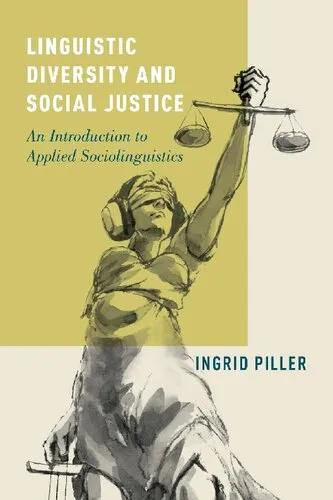
Cover of Linguistic Diversity and Social Justice: An Introduction to Applied Sociolinguistics

Book guide and evaluation

Linguistic Diversity and Social Justice: An Introduction to Applied Sociolinguistics

Ingrid Piller

English Beginner Essays
4.3 / 5

0 reviews

2016

Published

296

pages

343

views

Understanding and addressing linguistic disadvantage must be a central facet of the social justice agenda of our time. This book explores the ways in which linguistic diversity mediates social justice in liberal democracies undergoing rapid change due to high levels of migration

Before you read

What will you get from this book?

Understanding and addressing linguistic disadvantage must be a central facet of the social justice agenda of our time. This book explores the ways in which linguistic diversity mediates social justice in liberal democracies undergoing rapid change due to high levels of migration and economic globalization. Focusing on the linguistic dimensions of economic inequality, cultural domination and imparity of political participation, Linguistic Diversity and Social Justice employs a case-study approach to real-world instances of linguistic injustice. Linguistic diversity is a universal characteristic of human language but linguistic diversity is rarely neutral; rather it is accompanied by linguistic stratification and linguistic subordination. Domains critical to social justice include employment, education, and community participation. The book offers a detailed examination of the connection between linguistic diversity and inequality in these specific contexts within nation states that are organized as liberal democracies. Inequalities exist not only between individuals and groups within a state but also between states. Therefore, the book also explores the role of linguistic diversity in global injustice with a particular focus on the spread of English as a global language. While much of the analysis in this book focuses on language as a means of exclusion, discrimination and disadvantage, the concluding chapter asks what the content of linguistic justice might be.

Ask this book

Your question is answered in the context of this title and author. Each answer uses 2 points.

Sign in to ask the book assistant.

Reader reviews

0 reviews, 4.3 average out of 5

No reviews yet

If you have read this book, help the next reader with your experience.

Write a review

Sign in to publish a review.

Reader questions and answers

Ask a focused question and learn from the community.

Sign in to ask or answer a question.

No questions yet

Be the first to ask a clear, useful question.