
Book guide and evaluation
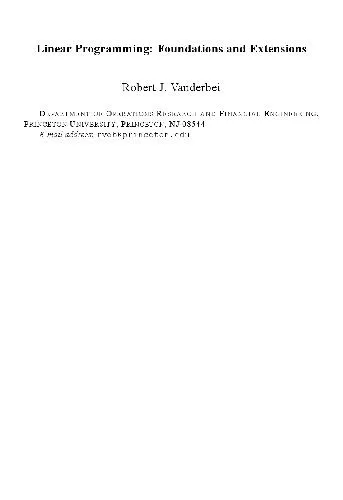
Linear Programming: Foundations and Extensions (2001)(2nd ed.)(en)(450s)
Vanderbei R. J.
English
Beginner
Economics
4.6 / 5
0 reviews
-
Published
466
pages
198
views
Introduction to "Linear Programming: Foundations and Extensions" (2nd Edition) Linear programming is one of the most fascinating and practical areas of optimization, with countless applications spanning engineering, economics, business, and even everyday problem-solving. T
Before you read
What will you get from this book?
Introduction to "Linear Programming: Foundations and Extensions" (2nd Edition)
Linear programming is one of the most fascinating and practical areas of optimization, with countless applications spanning engineering, economics, business, and even everyday problem-solving. This book, "Linear Programming: Foundations and Extensions" by Vanderbei R. J., offers a comprehensive exploration of the subject, blending theoretical rigor with practical insights. Designed for students, researchers, and professionals, this second edition expands on the foundational concepts while introducing updated techniques, algorithms, and real-world applications.
Detailed Summary of the Book
This extensively revised second edition covers the full breadth of linear programming (LP) with a systematic and accessible approach. The book begins by laying a solid foundation in the basics of linear optimization, starting with geometric interpretations to provide an intuitive understanding. Key concepts such as polyhedra, simplex methods, and duality are explained in detail, ensuring readers grasp the core ideas before advancing to more complex topics.
As the book progresses, it delves into cutting-edge extensions of linear programming, such as interior-point methods, quadratic programming, and convex optimization. Unlike many other texts, this book bridges the gap between pure theory and real-world applications. It expertly demonstrates how the principles of LP can be implemented in various fields, from telecommunications to transportation and beyond.
A unique feature of the book is its emphasis on computational aspects, including practical algorithm development and numerical solutions. Readers are guided through software implementations and taught how to build efficient computational models using modern tools. This makes the book equally suitable for those looking to solve applied optimization problems and for researchers interested in exploring algorithmic intricacies.
Throughout the text, clear explanations are complemented by illustrative examples, making it easier for readers to connect theoretical insights with practical scenarios. Exercises at the end of each chapter provide opportunities for deeper engagement, encouraging readers to solidify their understanding and explore advanced extensions.
Key Takeaways
- Comprehensive coverage of the fundamental principles and concepts of linear programming.
- In-depth exploration of modern algorithms, including simplex and interior-point methods.
- Practical insights into real-world applications of linear optimization problems.
- A bridge between theory and practice with significant emphasis on computational implementation.
- Exercises and problem-solving examples to foster active learning and mastery of concepts.
Famous Quotes From the Book
"Linear programming is the art and science of optimizing problems governed by constraints."
"Every optimization problem has a geometric soul. To solve it, one must connect the abstract mathematics to tangible intuition."
"The boundary of computational efficiency lies not just in algorithms but also in how creatively we model real-world problems."
Why This Book Matters
The relevance of this book lies in its ability to demystify a subject that might initially appear daunting. By presenting the material in a logical, step-by-step manner, Vanderbei ensures accessibility to readers with varying backgrounds. This makes the book a suitable companion for both students embarking on their journey of mathematical optimization and seasoned professionals looking to enhance their analytical toolkit.
Furthermore, the inclusion of extensions beyond traditional linear programming, such as quadratic and convex optimization, and a focus on computational techniques, ensures that the book reflects the latest advancements in the field. It is particularly noteworthy for its practical approach, which equips readers with both theoretical and computational tools necessary for solving complex optimization problems in their work or research.
As a comprehensive resource, "Linear Programming: Foundations and Extensions" not only serves as a foundational textbook but also as a reference guide for advanced topics. Its blend of clarity, depth, and practical applicability cements its place as a pivotal text in the field of operations research and applied optimization.
Ask this book
Your question is answered in the context of this title and author. Each answer uses 2 points.
Sign in to ask the book assistant.
Reader reviews
0 reviews, 4.6 average out of 5
No reviews yet
If you have read this book, help the next reader with your experience.
Write a review
Sign in to publish a review.
Reader questions and answers
Ask a focused question and learn from the community.
Sign in to ask or answer a question.
No questions yet
Be the first to ask a clear, useful question.
What to read next
Related references that continue this learning path.

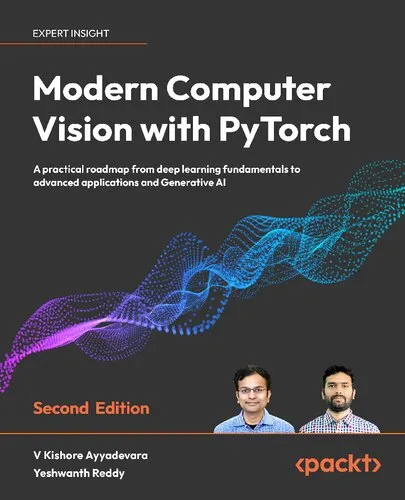
Modern Computer Vision with PyTorch: A Practical Roadmap From Deep Learning Fundamentals to Advanced Applications and Generative AI, 2nd Edition
V Kishore Ayyadevara,Yeshwanth Reddy
2023
View book