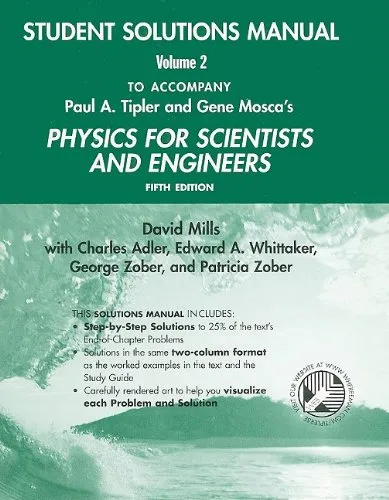
Physics for Scientists and Engineers Student Solutions Manual, Volume 2 (v. 2 & 3)
Gene Mosca,Todd Ruskell
2003
View book
Book guide and evaluation
Robert Gilmore
0 reviews
Published
pages
views
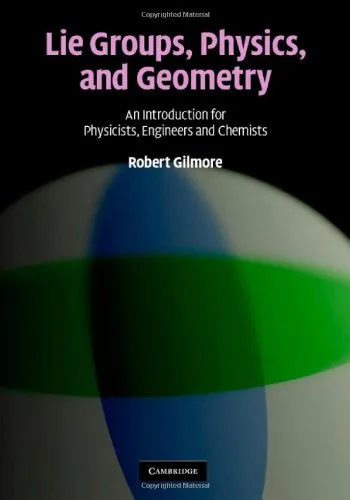
Introduction to "Lie Groups, Physics, and Geometry: An Introduction for Physicists, Engineers, and Chemists" "Lie Groups, Physics, and Geometry: An Introduction for Physicists, Engineers, and Chemists" is designed to bridge the gap between advanced theoretical ph
Before you read
"Lie Groups, Physics, and Geometry: An Introduction for Physicists, Engineers, and Chemists" is designed to bridge the gap between advanced theoretical physics, mathematics, and practical applications. Authored by Robert Gilmore, this book provides an accessible yet rigorous introduction to the fundamental concepts of Lie groups, their geometrical interpretations, and their significant role in physics, engineering, and chemistry.
The book masterfully blends abstract mathematical theory with concrete applications, making it an indispensable resource for students, researchers, and professionals in various scientific fields. Its conversational tone, clear examples, and focus on real-world relevance help readers traverse the complex intersections of mathematics and science with confidence.
This book starts by laying the foundational groundwork for understanding Lie groups, Lie algebras, and their associated geometries. The approach is structured to allow readers with diverse levels of exposure to mathematics to follow along. Topics like transformations, symmetry groups, and their relevance to modern physics and engineering systems are introduced in accessible language. Step-by-step calculations and geometric visualizations are employed to make these abstract concepts tangible.
The initial chapters delve into fundamental definitions and properties of Lie groups, emphasizing simple examples that grow in sophistication. These serve as a stepping stone to advanced discussions on symmetry principles that underpin much of modern physics, such as particle physics, quantum mechanics, and relativity. By connecting these mathematical structures to phenomena like conservation laws and quantum states, the book reveals why Lie groups are indispensable for understanding fundamental forces and symmetries in nature.
In the later chapters, applications of Lie groups to engineering and chemistry are explored in detail. Symmetry operations in molecular systems, control theory, and chaotic dynamics are presented as practical examples that hold immense relevance to working professionals. Alongside, the book provides problem sets aimed at developing an intuitive understanding and guiding further exploration.
"Symmetry forms the backbone of all natural and scientific phenomena; Lie groups are the language through which we understand and express this symmetry."
"Mathematics may appear abstract, but its applications bring clarity and elegance to the world of the unseen."
The significance of "Lie Groups, Physics, and Geometry" lies in its ability to illuminate the intricate relationship between mathematics and the physical universe. For physicists, it offers a roadmap to understanding the foundational symmetries that govern fundamental laws. For engineers, it unveils practical applications in control systems, robotics, and quantum computing. Chemists, on the other hand, will find insights into molecular symmetries and chemical dynamics.
The book is a testament to the power of interdisciplinary knowledge. By presenting Lie groups in a digestible manner, it democratizes access to a topic traditionally reserved for mathematicians while ensuring scientific rigor. It fosters appreciation for the universality of symmetry and its impact across fields, making it a critical addition to the library of any aspiring scientist or engineer.
More than just a reference, this book is a guide to intellectual curiosity, bridging abstract theory to pragmatic science. It inspires readers to think critically, explore connections, and contribute meaningfully to their respective disciplines.
Your question is answered in the context of this title and author. Each answer uses 2 points.
0 reviews, 4.4 average out of 5
Sign in to publish a review.
Ask a focused question and learn from the community.
Related references that continue this learning path.
Gene Mosca,Todd Ruskell