Lectures on Quantum Mechanics: With Problems, Exercises and their Solutions
Jean-Louis Basdevant
2016
View book
Book guide and evaluation
Howard Georgi
0 reviews
Published
pages
views
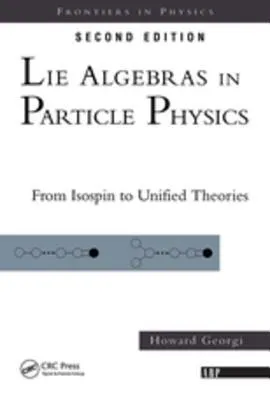
Introduction to 'Lie Algebras in Particle Physics: From Isospin to Unified Theories' Written by Howard Georgi, 'Lie Algebras in Particle Physics: From Isospin to Unified Theories' is a seminal text that provides physicists, mathematicians, and advanced students with a de
Before you read
Written by Howard Georgi, 'Lie Algebras in Particle Physics: From Isospin to Unified Theories' is a seminal text that provides physicists, mathematicians, and advanced students with a deep dive into the fascinating world of Lie algebras in the context of particle physics. This book, highly regarded in the scientific community, serves as both a thorough introduction to the subject and an essential reference for researchers working in theoretical physics. With a blend of conceptual simplicity and mathematical rigor, Georgi effectively navigates through the intricate foundations of Lie algebras, their physical implications, and their critical role in the development of modern unified theories.
This book stands as a bridge between abstract mathematics and practical physics, ensuring that the material is approachable without sacrificing its intellectual depth. It introduces the reader to isospin, fundamental symmetry principles, and extends to topics in gauge theories and grand unified theories, equipping readers with the tools needed to understand modern advancements in particle physics. Whether you are an academic professional, a theorist, or a student with a curiosity for symmetry in physics, this book is a cornerstone text for your journey. Let’s explore its key aspects in detail below.
'Lie Algebras in Particle Physics', often regarded as a masterclass in the study of symmetry, lays a robust foundation by starting with the historical development of isospin. It meticulously builds up to larger frameworks, explaining the powerful structure of Lie algebras—algebraic systems that describe symmetry transformations fundamental to the laws of particle physics. Topics like SU(2), SU(3), and their generalizations to larger Lie groups are explored thoroughly, using extensive physical examples from quantum mechanics and field theory.
The book outlines basic group theory, representation theory, and Lie algebras in a systematic yet accessible manner. Moving into practical applications, Georgi discusses the role of symmetry in constructing particle physics theories and explains how Lie algebra structures provide the backbone for understanding the Standard Model and beyond. The later chapters delve deeper into gauge symmetries, breaking mechanisms, representations of gauge groups, and the pursuit of unified theories. Especially notable is Georgi's treatment of grand unification, where he masterfully integrates mathematical formalism with physical intuition.
"Symmetry is not just a mathematical curiosity; it is central to our understanding of the fundamental forces of nature."
"Gauge symmetries are beautiful because they are both restrictive and predictive, forcing relationships between observables that would otherwise appear arbitrary."
"Lie groups and their algebras offer the language of symmetry, the hidden framework beneath the physics of particles."
'Lie Algebras in Particle Physics' is not just a textbook—it is a window into the underlying symmetry of the universe. By combining mathematical beauty with physical intuition, Howard Georgi provides an unmatched resource for understanding the role of Lie algebras in theoretical physics. The book's importance lies in its ability to help readers grasp the framework of modern particle physics while encouraging them to explore more advanced topics like grand unification and beyond.
Symmetry principles, as presented in this book, have shaped the discovery of the Standard Model of particle physics and the ongoing quest for its unification with gravity. For students, it serves as an excellent introduction to abstract algebraic concepts, while researchers appreciate its practical insights. The level of detail, clarity of presentation, and breadth of coverage make it indispensable for anyone interested in the mathematical underpinnings of physical reality.
Simply put, this book matters because it equips readers with the tools to think deeply and creatively about both the known and the unknown in fundamental physics.
Your question is answered in the context of this title and author. Each answer uses 2 points.
0 reviews, 4.7 average out of 5
Sign in to publish a review.
Ask a focused question and learn from the community.
Related references that continue this learning path.
Jean-Louis Basdevant
Arnold F. Nikiforov,Vladimir G. Novikov,V.B. Uvarov (auth.)