
Conflict and Compromise: The Strategy, Politics and Diplomacy of the French Blockade, 1914–1918
Marjorie Milbank Farrar (auth.)
1974
View book
Book guide and evaluation
William H. Riker
0 reviews
Published
pages
views
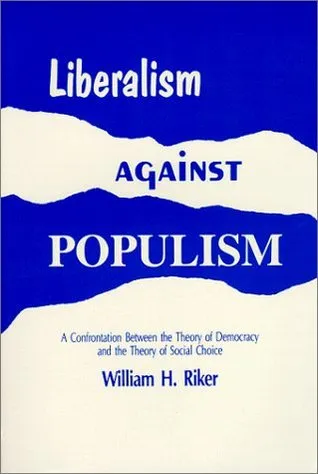
Introduction to "Liberalism Against Populism: A Confrontation Between the Theory of Democracy and the Theory of Social Choice" Authored by William H. Riker, Liberalism Against Populism is a profound exploration of the philosophical and mathematical tensions between the ideals
Before you read
Authored by William H. Riker, Liberalism Against Populism is a profound exploration of the philosophical and mathematical tensions between the ideals of democracy and the mechanisms of social choice. The book delves into the theory of democracy, its aspirations, and how these ideals are often at odds with the realities of aggregating individual preferences into collective decisions. By juxtaposing liberalism and populism, Riker invites readers to critically evaluate the foundations of democratic principles and the challenges they face in practice.
This book provides a systematic and analytical investigation of the intersection of democratic theory and social choice theory, a field pioneered by economist Kenneth Arrow. It revolves around the disconnect between the moral and philosophical ideals that undergird democracy and the technical imperfections revealed by social choice theory, such as the inability to design a voting method that flawlessly translates individual preferences into group decisions. By addressing this central tension, Riker argues for the necessity of liberalism to safeguard individual rights against the flaws inherent in populist-majoritarian decision-making.
For scholars, students of political science, and those interested in democratic theory, this book provides intellectual tools to critically question the processes and systems of governance, urging readers to reconcile democratic ideals with the limitations of collective decision-making.
In Liberalism Against Populism, Riker embarks on a comparison of two competing frameworks within democratic theory: the populist ideal and the liberal ideal. The populist approach sees democracy as the embodiment of the "will of the people," while the liberalist perspective emphasizes the protection of individual freedoms, acknowledging the imperfections of collective decision-making.
Riker begins by establishing the philosophical foundations of democracy and then transitions into its mechanical shortcomings. Drawing heavily on social choice theory and Arrow’s impossibility theorem, he demonstrates how no voting system can perfectly reflect the preferences of individuals without violating some fundamental criteria. This insight becomes the bedrock for his criticism of populism, which presumes that democracy can effectively manifest a unified public will.
The book systematically reveals how voting systems are vulnerable to manipulation, cyclical preferences, and non-transitive outcomes. Riker argues that these flaws necessitate a shift away from a naive populist view of democracy. Instead, he advocates for a liberal democracy, where the emphasis is placed on limiting government power and ensuring the protection of individual rights, as opposed to attempting to perfect an inherently imperfect system.
Riker masterfully intertwines theoretical insights with practical implications, highlighting how democratic systems function in the real world. By illustrating how political strategies, agendas, and voter behavior align with his theoretical framework, Riker provides a comprehensive critique of democratic ideals through the lens of social choice theory.
"Democratic choice is not and never can be a perfect and complete embodiment of the will of the people."
"It is liberalism, not populism, that provides a safeguard against the tyranny of the majority."
"Social choice theory reveals the fundamental flaws in our attempts to make collective decisions while maintaining individual autonomy."
William H. Riker’s Liberalism Against Populism is a cornerstone text in the study of democratic theory, offering a unique perspective grounded in the analytical rigor of social choice theory. The book is invaluable for anyone seeking to challenge the romanticized notions of democracy and develop a more nuanced understanding of its strengths and limitations. By bridging political theory with mathematical frameworks, Riker’s work equips readers with tools to critically evaluate the systems of governance they live under and consider the trade-offs inherent in any collective decision-making process.
Beyond academic circles, the book's insights hold significant implications for policymakers, advocates, and citizens who engage with democratic systems. It challenges readers to reflect on their beliefs about democracy, urging them to balance idealism with practicality. In an era of increasing polarization and populist pressures, Liberalism Against Populism remains as relevant today as it was when first published, making it an enduring contribution to political philosophy and social science.
Your question is answered in the context of this title and author. Each answer uses 2 points.
0 reviews, 4.5 average out of 5
Sign in to publish a review.
Ask a focused question and learn from the community.
Related references that continue this learning path.
Marjorie Milbank Farrar (auth.)


Friedel Bolle,Marco Lehmann-Waffenschmidt (auth.),Professor Dr. Friedel Bolle,Professor Dr. Marco Lehmann-Waffenschmidt (eds.)