A Comprehensive Introduction to Differential Geometry, Vol. 1, 3rd Edition
Michael Spivak
1999
View book
Book guide and evaluation
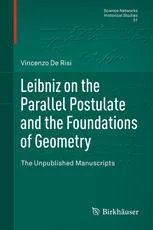
Vincenzo De Risi (auth.)
0 reviews
Published
pages
views
Leibniz's work in mathematics and philosophy has been widely celebrated, but his contributions to geometry have often remained in the shadow of his more prominent achievements. Leibniz on the Parallel Postulate and the Foundations of Geometry: The Unpublished Manuscripts sh
Before you read
Leibniz's work in mathematics and philosophy has been widely celebrated, but his contributions to geometry have often remained in the shadow of his more prominent achievements. Leibniz on the Parallel Postulate and the Foundations of Geometry: The Unpublished Manuscripts sheds new light on the great philosopher’s engagement with the foundational questions in geometry, specifically his exploration of the contentious parallel postulate. This book takes the reader on an intellectual journey through unpublished manuscripts, bringing to life the profound ideas and challenges that shaped Leibniz's efforts in this field.
In this comprehensive examination, the book delves into Leibniz’s unpublished writings, exploring how he grappled with the logical structure of geometry and the problem of the parallel postulate. For centuries, the parallel postulate—one of the foundational axioms of Euclid's geometry—posed a significant challenge to mathematicians and philosophers alike. Leibniz, known for his systematic and rigorous approach, engaged deeply with this issue, attempting to either derive the postulate from other axioms or to reconceptualize the logical framework of geometry entirely.
The book outlines Leibniz's critique of Euclidean geometry as well as his broader philosophical aim to unify geometrical reasoning under the umbrella of metaphysics and logic. Through careful analysis of his unpublished manuscripts, we gain insight into his approach to the axioms of geometry as contingent truths rather than necessary ones, revealing a radical vision of the subject that in some ways anticipates modern geometrical thinking.
Moreover, the book reveals Leibniz's dialogue with other intellectual figures of his era and how he positioned his ideas within the broader scientific and philosophical debates of the time. By piecing together his thoughts on infinite constructs, the nature of space, and the use of logic in geometry, this book provides a rich and detailed account of one of the least explored yet critical aspects of his oeuvre.
"Geometry is not merely a set of definitions and postulates, but a reflection of the fundamental order of the universe as manifest in space." – G.W. Leibniz
"The parallel postulate is not a necessary truth, for the proposition does not follow from the very nature of space but depends upon the peculiarities of our perceptions." – G.W. Leibniz
"To understand geometry's principles is to uncover the metaphysical truths that bind reality, reason, and imagination." – G.W. Leibniz
Leibniz's reflections on geometry form an essential part of his philosophy and showcase the depth of his intellectual curiosity. While his contributions to calculus and metaphysics have been widely acknowledged, this book highlights a lesser-known but equally significant aspect of his legacy. By analyzing his unpublished manuscripts, Leibniz on the Parallel Postulate and the Foundations of Geometry not only fills a gap in Leibnizian studies but also prompts reevaluation of how foundational debates in geometry influenced the trajectory of modern mathematics.
Furthermore, this book provides a unique opportunity for mathematicians, philosophers, and historians to explore an intersection of disciplines—spanning geometry, logic, and metaphysics—that continues to fuel discussions in contemporary academia. It underscores Leibniz as not merely a mathematician or philosopher but as a thinker who constantly sought unity and coherence across all fields of human knowledge.
In engaging with the profound challenges posed by the parallel postulate, Leibniz’s manuscripts offer a timeless exploration of the nature of mathematical truths, the limits of reason, and the beauty of intellectual inquiry itself.
Your question is answered in the context of this title and author. Each answer uses 2 points.
0 reviews, 4.5 average out of 5
Sign in to publish a review.
Ask a focused question and learn from the community.
Related references that continue this learning path.
Michael Spivak
Svetlana Cojocaru,Svetlana Cojocaru,Gerhard Pfister,Victor Ufnarovski