
Book guide and evaluation
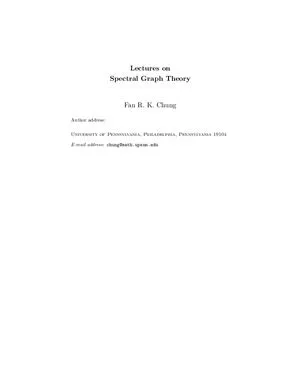
Lectures on Spectral Graph Theory
Chung F.R.K.
English
Beginner
Graph Theory
4.6 / 5
0 reviews
-
Published
25
pages
754
views
Introduction to "Lectures on Spectral Graph Theory" Welcome to an in-depth exploration of "Lectures on Spectral Graph Theory", a riveting guide that unlocks the mathematical and practical wonders of graphs through the lens of spectral theory. This profound work is design
Before you read
What will you get from this book?
Introduction to "Lectures on Spectral Graph Theory"
Welcome to an in-depth exploration of "Lectures on Spectral Graph Theory", a riveting guide that unlocks the mathematical and practical wonders of graphs through the lens of spectral theory. This profound work is designed for both newcomers and seasoned scholars in graph theory, with a keen interest in the spectral properties that govern network dynamics.
Detailed Summary
In "Lectures on Spectral Graph Theory," readers are introduced to the fundamental concepts of spectral graph theory, which is the study of properties of a graph in relationship to the characteristics of eigenvalues and eigenvectors of matrices associated with the graph, such as the adjacency matrix and the Laplacian matrix. The book is organized in a series of well-structured lectures that gradually build a comprehensive understanding from basic principles to more advanced topics.
The initial chapters provide an introduction to the essential concepts of graph theory, including definitions and the foundational theorems. As we move forward, the book delves into spectral properties by discussing the significance of eigenvalues, and how they can reveal critical insights into the graph's structure and behavior.
The later chapters introduce more sophisticated topics such as spectral partitioning, and expander graphs, and discuss the various applications of spectral methods in computer science, physics, and beyond. These applications showcase how spectral techniques can solve practical problems like network connectivity and robustness analysis.
Key Takeaways
- Understanding the connection between graph structure and the spectrum of matrices.
- Insights into the role of eigenvalues in predicting graph behavior.
- A comprehensive look at the Laplacian matrix and its applications.
- Applications of spectral graph theory in various fields such as computer science, engineering, and sociology.
Famous Quotes from the Book
“Spectral graph theory provides us with tools to see networks not just as connection and node, but as a complex interplay of interrelated forces shaping the very nature of connectivity.”
“The eigenvalues of a graph are much like a fingerprint for human identity; they uniquely characterize the structure and behavior of a network.”
Why This Book Matters
This book stands out as an essential resource in the field of graph theory, especially for those keen to delve into the spectral aspects. Understanding spectral graph theory is crucial for tackling contemporary challenges in data science, where networks play an integral role. By deciphering the spectral characteristics of networks, researchers and practitioners can gain insights into network resilience, optimize complex systems, and innovate in fields such as social network analysis, machine learning, and bioinformatics.
Moreover, the conceptual clarity and structured approach of "Lectures on Spectral Graph Theory" make it accessible to learners with varying degrees of familiarity with mathematics and graph theory. Whether you're a student seeking to enhance your knowledge in the domain of graph theory, a researcher pushing the boundaries of network science, or an industry professional aiming to apply these concepts in real-world scenarios, this book serves as a valuable guide and reference point.
Ask this book
Your question is answered in the context of this title and author. Each answer uses 2 points.
Sign in to ask the book assistant.
Reader reviews
0 reviews, 4.6 average out of 5
No reviews yet
If you have read this book, help the next reader with your experience.
Write a review
Sign in to publish a review.
Reader questions and answers
Ask a focused question and learn from the community.
Sign in to ask or answer a question.
No questions yet
Be the first to ask a clear, useful question.
What to read next
Related references that continue this learning path.
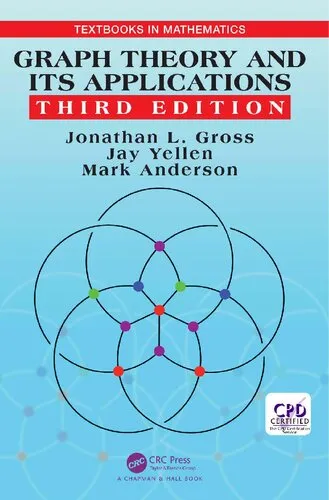
Graph Theory and Its Applications (Textbooks in Mathematics)
Jonathan L. Gross,Jay Yellen,Mark Anderson
2018
View book