

Book guide and evaluation
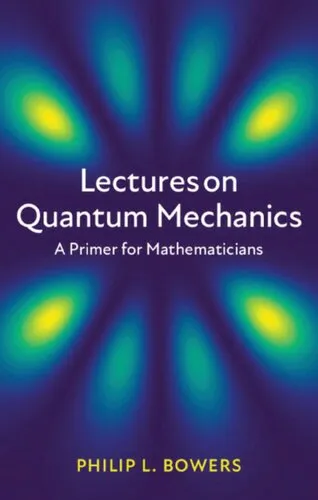
Lectures on Quantum Mechanics: A Primer for Mathematicians
Philip L. Bowers
English
Beginner
Physics
4.0 / 5
0 reviews
2020
Published
584
pages
123
views
Introduction Welcome to Lectures on Quantum Mechanics: A Primer for Mathematicians, a book designed to bridge the gap between the rigorous beauty of mathematical theory and the intricate, fascinating world of quantum mechanics. Whether you are a mathematician delving into phys
Before you read
What will you get from this book?
Introduction
Welcome to Lectures on Quantum Mechanics: A Primer for Mathematicians, a book designed to bridge the gap between the rigorous beauty of mathematical theory and the intricate, fascinating world of quantum mechanics. Whether you are a mathematician delving into physics or a scientist enriching your mathematical understanding, this book provides the tools and insights to navigate the quantum realm with precision and clarity. Here, we unravel the complexities of quantum theory, starting from foundational principles and advancing toward significant mathematical formulations central to the field.
Detailed Summary of the Book
The book begins with a thorough exploration of the basic principles of quantum mechanics, focusing on its underpinnings in both classical physics and modern mathematics. Topics such as wave functions, operators, and the Schrödinger equation are introduced through a lens that emphasizes mathematical rigor while maintaining accessibility. Subsequent chapters delve deeper into the probabilistic framework of quantum mechanics, examining key concepts like Hilbert spaces and self-adjoint operators, which serve as the backbone of quantum theory.
The narrative seamlessly transitions into the study of quantum states and observables, paying special attention to the postulates of the theory. Important tools such as matrix mechanics and Dirac notation are covered in detail, along with discussions on Heisenberg's uncertainty principle and its implications. A key feature of the book is its discussion of quantum harmonic oscillators, spin systems, and symmetries in quantum mechanics, all presented with clear mathematical derivations.
As the book progresses, readers are introduced to advanced topics, including perturbation theory, the principles of quantum entanglement, and the mathematical framework behind measurement and eigenvalue problems. The interplay between mathematics and physics is explored through examples and problem sets, designed to solidify understanding and encourage further exploration.
Key Takeaways
- A clear and rigorous understanding of the mathematical foundations of quantum mechanics, from linear algebra to operator theory.
- Insights into the fundamental principles of quantum theory, such as wave-particle duality, superposition, and measurement.
- Practical exposure to problem-solving techniques in quantum mechanics, facilitated by carefully chosen examples and exercises.
- An appreciation for the symbiotic relationship between mathematics and physics in the evolution of quantum theory.
Famous Quotes from the Book
"Quantum mechanics is not merely a branch of physics; it is a profound and transformative way of thinking about the natural world."
"Mathematics serves as the bedrock of quantum mechanics, providing the structure and language to express its enigmatic principles."
"Understanding the mathematics of quantum mechanics is a journey, not merely toward solutions but toward deeper appreciation of the universe's complexities."
Why This Book Matters
Quantum mechanics is at the heart of modern science and technology, influencing fields as diverse as quantum computing, cryptography, and particle physics. Yet, it remains one of the most challenging subjects to approach, especially for those with strong mathematical inclinations but limited exposure to physical theory. This book makes quantum mechanics accessible by emphasizing the interplay of mathematics and physics, providing readers with a well-rounded perspective and a solid foundation for further study.
By focusing on concepts, structures, and reasoning, Lectures on Quantum Mechanics invites mathematicians and scientists alike to appreciate quantum mechanics not only as an empirical science but also as an intellectual discipline rooted in elegant mathematical ideas. The book is a call to curiosity and discovery, crafted to inspire intellectual growth and a lifelong fascination with the quantum world.
Ask this book
Your question is answered in the context of this title and author. Each answer uses 2 points.
Sign in to ask the book assistant.
Reader reviews
0 reviews, 4.0 average out of 5
No reviews yet
If you have read this book, help the next reader with your experience.
Write a review
Sign in to publish a review.
Reader questions and answers
Ask a focused question and learn from the community.
Sign in to ask or answer a question.
No questions yet
Be the first to ask a clear, useful question.
What to read next
Related references that continue this learning path.


Modern Computer Vision with PyTorch: A Practical Roadmap From Deep Learning Fundamentals to Advanced Applications and Generative AI, 2nd Edition
V Kishore Ayyadevara,Yeshwanth Reddy
2023
View book