
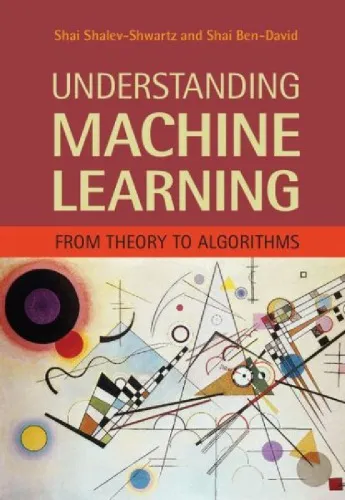
Understanding Machine Learning: From Theory to Algorithms
Shalev-Shwartz S.,Ben-David S.
2014
View book

Book guide and evaluation
N Bellomo;Mauro Lo Schiavo
0 reviews
Published
pages
views
Introduction to "Lecture Notes on the Mathematical Theory of Generalized Boltzmann Models" The "Lecture Notes on the Mathematical Theory of Generalized Boltzmann Models" provides an incisive and methodical exploration of the mathematical underpinnings of the Boltzmann equa
Before you read
The "Lecture Notes on the Mathematical Theory of Generalized Boltzmann Models" provides an incisive and methodical exploration of the mathematical underpinnings of the Boltzmann equation and its various extensions. Written by accomplished authors, this book bridges the gap between traditional kinetic theory and advanced applications in modern science, offering a refreshing dive into the realm of generalized Boltzmann models.
The Boltzmann equation, a cornerstone of statistical mechanics and mathematical physics, has inspired generations of mathematicians and scientists. In this book, the authors delve into key generalizations of the theory, addressing its use in diverse fields, including biological systems, social dynamics, and beyond. Aimed at graduate students, researchers, and professionals in applied mathematics, physics, and engineering, this book presents a rigorous yet accessible platform to grasp the evolving nature of Boltzmann models in contemporary science.
The book meticulously introduces readers to the traditional Boltzmann equation and guides them through its evolution into generalized frameworks. It begins by revisiting the original formulation of the equation, highlighting its historical significance and mathematical importance in describing gas dynamics. Gradually, the text expands into non-classical realms, exploring how the Boltzmann equation can be adapted to model multi-agent systems, complex biological systems, and social dynamics.
The book emphasizes topics such as:
The authors integrate formal mathematical theorems with illustrative examples, facilitating a deeper understanding of theoretical results and their practical implications. A key highlight of the book lies in its elegant exposition of multi-scale modeling techniques, which enable the connection of micro-level dynamics to macro-level phenomena.
This book offers a unique blend of rigorous mathematics and real-world applications. Some key takeaways include:
"The Boltzmann equation, far from being a static relic of 19th-century physics, continues to inspire new generations of scientists as they adapt its principles to model the dynamic complexity of the modern world."
"Mathematics is not just the backbone of our models; it is the language that unveils the intricate interactions hidden within complex systems."
This book stands as a testament to the evolving nature of mathematical modeling and its significance in understanding complex systems. The innovations introduced by generalized Boltzmann models are paving the way for breakthroughs in disciplines as diverse as biology, sociology, and economics.
By merging mathematical rigor with a practical spirit, this book equips readers with the tools required to tackle real-world challenges. Whether you are a mathematician seeking theoretical insights or a scientist aiming to apply kinetic theory in new contexts, this book provides an invaluable resource. It beautifully illustrates how classical theories can serve as a foundation for addressing modern interdisciplinary problems.
Moreover, the emphasis on teaching mathematical concepts in a clear and structured manner ensures that students and professionals alike will find this book highly engaging and enlightening. The breadth of topics discussed, coupled with the depth of mathematical analysis, truly sets this book apart.
Your question is answered in the context of this title and author. Each answer uses 2 points.
0 reviews, 4.8 average out of 5
Sign in to publish a review.
Ask a focused question and learn from the community.
Related references that continue this learning path.
Shalev-Shwartz S.,Ben-David S.

Prof. Dr. Josef Stoer,Dr. Christoph Witzgall (auth.)

Vincenzo Capasso,David Bakstein