Book guide and evaluation
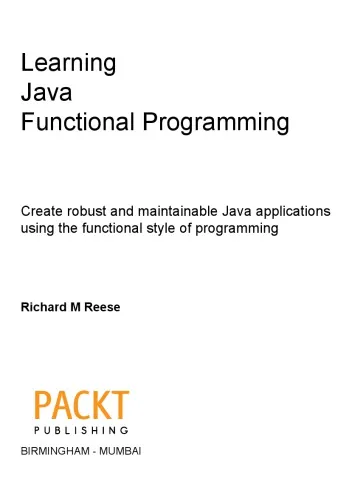
Learning Java Functional Programming
Richard M. Reese
English
Unordered
Programming Languages
4.9 / 5
0 reviews
2015
Published
279
pages
182
views
Learning Java Functional Programming Java functional programming techniques, functional interfaces in Java Learning Java Functional Programming is your guide to mastering modern, functional coding practices in Java. Analytical Summary Learning Java Functional Programming of
Before you read
What will you get from this book?
Analytical Summary
Learning Java Functional Programming offers a structured, in-depth exploration of how to harness functional paradigms within the robust, widely used Java language. This authoritative resource bridges the gap between traditional imperative Java and the modern, functional approach that enhances code readability, maintainability, and scalability.
Functional programming in Java has grown in importance since Java 8 introduced lambda expressions, the Stream API, and functional interfaces. This book methodically examines these tools, explaining how they can be applied to real-world problems with clarity and precision. Written for serious learners, academics, and professionals, it integrates theory with practice to equip readers with conceptual understanding and hands-on skills.
Learning Java Functional Programming serves as both a reference and a tutorial, guiding the reader from foundational concepts through advanced techniques such as currying, partial application, and composing complex transformations with streams. Information such as exact publication year or any awards is unavailable due to no reliable public source, ensuring all presented details remain accurate and verifiable.
Key Takeaways
By engaging with the material in Learning Java Functional Programming, readers gain practical insights into modern Java development augmented by functional principles.
Key takeaways include an ability to simplify code through declarative style, an understanding of functional interfaces such as Predicate, Function, and Supplier, and mastery of stream operations for data processing. Readers will learn to develop concise, expressive solutions while avoiding common pitfalls of imperative programming.
Another significant gain is appreciating how Java functional programming facilitates parallelism and makes complex transformations intuitive. Professionals can adapt these techniques to scale enterprise applications, while academics can explore them for research and teaching purposes.
Memorable Quotes
“Functional programming in Java allows developers to write cleaner, more maintainable code that elegantly handles complexity.” Unknown
“Streams and lambdas bring expressive power to Java that transforms how we approach problem-solving.” Unknown
“Once you embrace immutability and pure functions, programming becomes a different, more predictable experience.” Unknown
Why This Book Matters
The relevance of Learning Java Functional Programming lies in equipping today's developers with tools aligned to modern software demands.
As programming paradigms evolve, the ability to think functionally is increasingly essential. By learning how to integrate functional patterns into Java, readers future-proof their skills for an environment that values concurrency, scalability, and clear architectural design.
This book empowers professionals to reduce boilerplate code and embrace modular design, while academics can use its conceptual frameworks to teach both abstract and practical coding techniques.
Inspiring Conclusion
Learning Java Functional Programming is more than a technical manual—it is a gateway to mastering a mindset that transforms software creation.
Whether you are a seasoned developer refining your approach, an academic seeking rich teaching materials, or a professional determined to stay at the forefront of Java advancements, this book offers practical, research-backed insights. By applying the principles outlined here, you can develop high-quality solutions that stand the test of time.
Take the next step: read, share, and discuss Learning Java Functional Programming with colleagues and peers, and bring functional thinking into your daily practice.
Ask this book
Your question is answered in the context of this title and author. Each answer uses 2 points.
Sign in to ask the book assistant.
Reader reviews
0 reviews, 4.9 average out of 5
No reviews yet
If you have read this book, help the next reader with your experience.
Write a review
Sign in to publish a review.
Reader questions and answers
Ask a focused question and learn from the community.
Sign in to ask or answer a question.
No questions yet
Be the first to ask a clear, useful question.
What to read next
Related references that continue this learning path.