

Book guide and evaluation
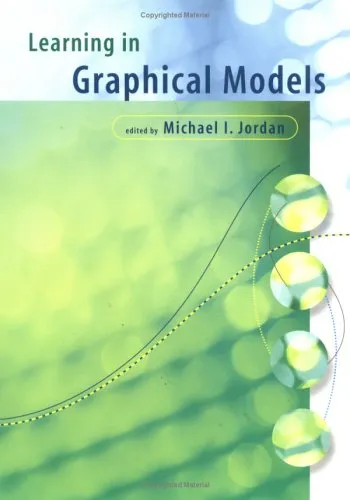
Learning in Graphical Models (Adaptive Computation and Machine Learning)
Michael I. Jordan (Editor)
English
Beginner
Software Engineering
4.4 / 5
0 reviews
1998
Published
615
pages
168
views
Introduction to "Learning in Graphical Models (Adaptive Computation and Machine Learning)" "Learning in Graphical Models," edited by Michael I. Jordan, serves as a cornerstone in the field of machine learning, particularly in the study of probabilistic graphical models. Pu
Before you read
What will you get from this book?
Introduction to "Learning in Graphical Models (Adaptive Computation and Machine Learning)"
"Learning in Graphical Models," edited by Michael I. Jordan, serves as a cornerstone in the field of machine learning, particularly in the study of probabilistic graphical models. Published as part of the Adaptive Computation and Machine Learning series, this book explores the intersection of statistical modeling, artificial intelligence, and computation. Graphical models—a framework unifying probability theory with graph theory—have revolutionized how we represent large-scale systems under uncertainty. This book unpacks foundational theories, cutting-edge methodologies, and practical algorithms to advance your understanding of this pivotal area of study.
In this collection, notable contributors from academia and industry come together to present a range of perspectives. Readers will find content covering inference algorithms, reinforcement learning, Bayesian networks, and applications across diverse scientific disciplines, including bioinformatics, finance, and natural language processing. Whether you are a researcher, student, or practitioner, this text equips you with tools to leverage graphical models in solving real-world problems.
Summary of the Book
The book is organized into several chapters focusing on various aspects of graphical models, categorizing them by theoretical foundations, learning algorithms, and their applications. Expect in-depth discussions on Bayesian networks and Markov models, the core constructs that underpin graphical models. The authors address the dual challenges of representation and computation, discussing techniques that allow for scalability and accuracy in modeling.
A noteworthy emphasis is placed on learning—both supervised and unsupervised—and inference processes, which are critical for graphical models to extract meaningful insights from data. Deep dives into topics like variational methods, expectation-maximization, and Markov chain Monte Carlo (MCMC) show how these concepts are translated into computational algorithms.
The book also explores real-world applications of graphical models, demonstrating how they are used for tasks such as speech recognition, image processing, and even genomics. It balances theory with practice, dedicating time to demonstrating how the abstract ideas are both implemented and tested. Through case studies and practical examples, readers gain insights into the flexibility and power of graphical models.
Key Takeaways from the Book
- A coherent framework for combining probabilistic models and graph theory to represent and reason about complex systems.
- Detailed algorithms for learning and inference, including both exact and approximate methods.
- Understanding of Bayesian networks, Markov networks, and their applications in various fields of science.
- Introduction to cutting-edge ideas like variational methods and hybrid Monte Carlo methods.
- Insights into how these models are used in industry—from natural language processing to financial forecasting.
Famous Quotes from the Book
"Graphical models provide a natural way of capturing dependencies among random variables and have become a cornerstone for reasoning under uncertainty in both research and applications."
"The key challenge in learning graphical models is not merely estimating parameters but crafting models that scale gracefully with complexity."
"Inference in graphical models unifies computation and probability theory, paving the way for powerful, data-driven discovery."
Why This Book Matters
"Learning in Graphical Models" is recognized as a seminal text that has shaped modern machine learning and probabilistic reasoning. The book is of particular significance because it bridges theory and practice, offering readers the foundational knowledge they need alongside tools for tackling real-world challenges. As industries and research increasingly turn to AI for solving complex problems, the role of probabilistic models has only grown more critical.
This book serves as a roadmap for navigating the rapidly evolving landscape of machine learning. By compiling contributions from leading researchers, it provides access to diverse perspectives that push the boundaries of what's possible with graphical models. More importantly, it encourages readers to engage critically with the material, fostering creativity and innovation in applying these models to uncharted domains.
Whether you're interested in building robust systems for data-driven decision-making or advancing the scope of artificial intelligence, this book is an essential addition to your library. It not only clarifies challenging concepts but also inspires a deeper appreciation for the beauty of mathematics, computation, and their union.
Ask this book
Your question is answered in the context of this title and author. Each answer uses 2 points.
Sign in to ask the book assistant.
Reader reviews
0 reviews, 4.4 average out of 5
No reviews yet
If you have read this book, help the next reader with your experience.
Write a review
Sign in to publish a review.
Reader questions and answers
Ask a focused question and learn from the community.
Sign in to ask or answer a question.
No questions yet
Be the first to ask a clear, useful question.
What to read next
Related references that continue this learning path.


Modern Computer Vision with PyTorch: A Practical Roadmap From Deep Learning Fundamentals to Advanced Applications and Generative AI, 2nd Edition
V Kishore Ayyadevara,Yeshwanth Reddy
2023
View book