
Book guide and evaluation
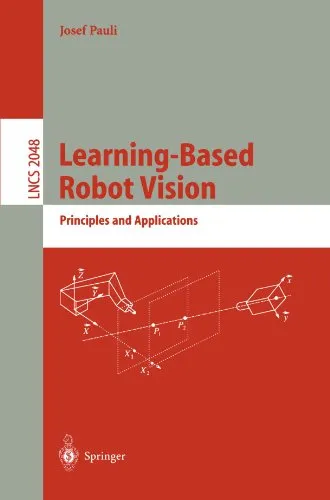
Learning-Based Robot Vision: Principles and Applications
Josef Pauli (auth.)
English
Intermediate
Product Management
4.3 / 5
0 reviews
2001
Published
291
pages
476
views
Introduction to Learning-Based Robot Vision: Principles and Applications In the rapidly evolving domain of artificial intelligence, the intersection of robotics and computer vision stands out as a particularly fascinating area of study. "Learning-Based Robot Vision: Principles
Before you read
What will you get from this book?
Introduction to Learning-Based Robot Vision: Principles and Applications
In the rapidly evolving domain of artificial intelligence, the intersection of robotics and computer vision stands out as a particularly fascinating area of study. "Learning-Based Robot Vision: Principles and Applications" seeks to demystify this complex field, providing a comprehensive exploration of how learning-based approaches are transforming robotic vision and, by extension, the capabilities of autonomous systems.
Detailed Summary of the Book
In "Learning-Based Robot Vision: Principles and Applications," we delve into the mechanisms that empower robots to perceive and interpret their surroundings. This book is structured to guide readers from foundational principles to the cutting-edge applications of learning-based vision systems. The initial chapters lay out the essential theories of machine learning and how they relate to visual perception. Concepts such as supervised, unsupervised, and reinforcement learning are dissected to provide a solid grounding.
As the narrative progresses, the book delves into practical applications of these theories in robotic systems. The deployment of convolutional neural networks (CNNs), recurrent neural networks (RNNs), and other architectures in vision tasks is explored in detail. Examples from real-world applications offer a tangible context for these abstract constructs. Additionally, the text examines challenges such as variability in lighting, occlusions, and motion blur, emphasizing robust techniques for overcoming these hurdles.
The later sections of the book are dedicated to advanced topics like semantic segmentation, object detection, and the integration of vision with other sensory inputs. Insights into the future of robotic vision—a future driven by increased autonomy and efficiency—are offered as a finale, sparking ideas for further research and innovation.
Key Takeaways
- Comprehensive understanding of the intersection between machine learning and computer vision in robotics.
- A thorough overview of learning models and their application to visual perception tasks within robotic systems.
- Insight into overcoming practical challenges such as variability in environmental conditions and integrating multiple sensory inputs.
- Exploration of real-world applications and future trends in learning-based robot vision.
Famous Quotes from the Book
"The true potential of robotics lies not just in its ability to perform programmed tasks, but in its capacity to learn and adapt through vision."
"Vision is not merely the window to the world for robots; it is the bridge to understanding."
Why This Book Matters
The prevalence of robots in various industries—from manufacturing and healthcare to logistics and autonomous vehicles—has highlighted the critical role of vision systems. This book matters because it equips practitioners, researchers, and students with the necessary insights and techniques to harness the power of learning-based approaches in robotic vision. Through its comprehensive treatment of both theoretical concepts and practical applications, this work serves as both a textbook and a field guide for those navigating the ever-evolving landscape of intelligent machine perception.
Furthermore, by bridging the gap between theory and practice, "Learning-Based Robot Vision: Principles and Applications" empowers its audience to pioneer new solutions, driving forward the capabilities of autonomous systems. The foresight provided on future trends also makes it an essential read for anyone looking to anticipate and participate in the next wave of technological advancement in robotics.
Ask this book
Your question is answered in the context of this title and author. Each answer uses 2 points.
Sign in to ask the book assistant.
Reader reviews
0 reviews, 4.3 average out of 5
No reviews yet
If you have read this book, help the next reader with your experience.
Write a review
Sign in to publish a review.
Reader questions and answers
Ask a focused question and learn from the community.
Sign in to ask or answer a question.
No questions yet
Be the first to ask a clear, useful question.
What to read next
Related references that continue this learning path.

Turn the Ship Around! - A True Story of Turning Followers into Leaders
L. David Marquet
2013
View book