React Interact: Situations for Communication, Third Edition
Donald R. H. Byrd,Isis C. Clemente
2001
View book
Book guide and evaluation
Muir A.
0 reviews
Published
pages
views
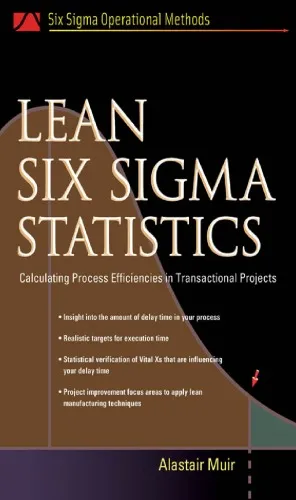
Introduction to "Lean Six Sigma Statistics: Calculating Process Efficiencies in Transactional Projects" "Lean Six Sigma Statistics: Calculating Process Efficiencies in Transactional Projects" is a blend of analytical rigor and practical strategies tailored for professionals na
Before you read
"Lean Six Sigma Statistics: Calculating Process Efficiencies in Transactional Projects" is a blend of analytical rigor and practical strategies tailored for professionals navigating the intricacies of transaction-based business processes. This book is written for those who not only seek to grasp the nuances of Lean Six Sigma methodologies but also want to master the statistical tools that drive measurable results.
The book focuses on delivering profound insights into process improvement methodologies while breaking down the complex aspects of statistical calculations used in Lean Six Sigma projects. Written with clarity and precision, it guides readers through the intersection of statistical data and process optimization, enabling them to make decisions based on facts rather than assumptions.
The goal of this publication is to bridge the gap between theory and practice by contextualizing statistical concepts within real-world transactional environments like customer services, finance, healthcare, and IT. Whether you are a Six Sigma Green Belt, a process analyst, or a business executive, this book equips you with the tools, definitions, and calculations you need to succeed in highly competitive business landscapes.
This book encapsulates the essence of Lean Six Sigma through the lens of data-driven decision-making. Divided into manageable and detailed sections, it begins by laying a foundation for Lean Six Sigma principles, emphasizing their reliance on statistical precision. With a strong emphasis on transactional projects, the book moves through key topics including process mapping, benchmarking, and statistical analysis tools such as control charts, capability indices, and root cause analysis.
The narrative actively focuses on actionable takeaways. Instead of simply explaining the "what" behind the numbers, it delves into the practical "how" to calculate and interpret them. From calculating process efficiencies and sigma levels to analyzing variation in systems, the book ensures a comprehensive approach, connecting every concept to its real-world use case.
Additionally, exercises and examples are woven into each chapter, reinforcing the learning process. Readers will leave equipped to apply Lean Six Sigma methodologies in improving operational efficiencies, managing defects, and achieving customer satisfaction, all through a statistical lens.
"Efficiency is not about doing more in less time; it’s about doing the right things, at the right time, with the least amount of waste."
"Statistics tell a story, but you must ensure that the numbers are the right numbers and that the story is worth listening to."
"Transactional projects often operate in gray areas. Lean Six Sigma provides the clarity needed to transform confusion into actionable results."
In a business world where decisions are too often driven by intuition or anecdotal evidence, the importance of data-backed strategies cannot be overstated. This book provides a beacon for those looking to improve transactional processes systematically and sustainably. It elevates the Lean Six Sigma methodology beyond manufacturing—and dives deep into the transactional sector, where inefficiencies can lurk unseen and unaddressed.
Organizations today must strike a delicate balance between high-quality outcomes, cost efficiency, and customer satisfaction. By emphasizing the critical role of statistics in achieving this balance, the book equips modern professionals with tools to thrive. In a broader sense, it serves as a guide for cultivating a culture of operational excellence through continuous improvement and fact-based decision-making.
Whether you are spearheading process improvement initiatives or working as part of a cross-departmental team, "Lean Six Sigma Statistics: Calculating Process Efficiencies in Transactional Projects" ensures you have the statistical expertise and operational insight to achieve measurable, meaningful outcomes.
Your question is answered in the context of this title and author. Each answer uses 2 points.
0 reviews, 4.2 average out of 5
Sign in to publish a review.
Ask a focused question and learn from the community.
Related references that continue this learning path.
Donald R. H. Byrd,Isis C. Clemente