

Cryptoassets: The Innovative Investor’s Guide to Bitcoin and Beyond
Chris Burniske,Jack Tatar
2017
View book
Book guide and evaluation
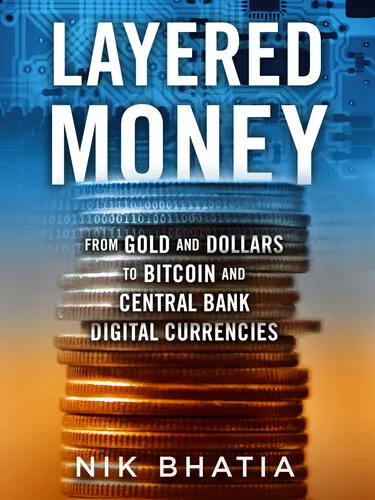
Nik Bhatia
0 reviews
Published
pages
views
Introduction to 'Layered Money: From Gold and Dollars to Bitcoin and Central Bank Digital Currencies' Finance is the lifeblood of modern civilization, and at the core of all financial systems lies money—a layered construct that has evolved for centuries. In Layered Money
Before you read
Finance is the lifeblood of modern civilization, and at the core of all financial systems lies money—a layered construct that has evolved for centuries. In Layered Money: From Gold and Dollars to Bitcoin and Central Bank Digital Currencies, I aim to unravel the complex, layered history of money while charting its transformative journey from ancient gold systems to the decentralized power of Bitcoin and beyond. This book connects the dots in monetary history, bridging the gap between traditional finance and the digital revolution that is reshaping the global economy.
The concept of layering in money provides clarity on how the financial system is structured. By dissecting these layers, this book examines the relationships between individuals, institutions, governments, and now, decentralized technologies like Bitcoin. Through vivid storytelling and in-depth analysis, Layered Money takes the reader on a journey that begins with gold at the foundation of money, flows into the dominance of government-issued currencies like the US Dollar, and culminates in Bitcoin’s arrival as a decentralized alternative and the potential rise of Central Bank Digital Currencies (CBDCs).
The book opens by discussing the origins of money, particularly how early civilizations relied upon commodities such as gold for trade and commerce. These physical commodities were the "first layer" of money, providing a fundamental base of trust and value. As society evolved, layers of abstraction were introduced. Governments began issuing paper currency as a "second layer" backed by gold reserves. Over time, with the abandonment of the gold standard, fiat currencies like the US Dollar became dominant, facilitated by financial institutions that added their own layers of credit and trust.
Bitcoin, introduced in 2009, adds a radically new layer to the architecture of money: decentralization. Unlike traditional fiat systems controlled by central authorities, Bitcoin operates independently of institutions, challenging the monopoly of state-controlled money. The book explores its core principles, such as scarcity, transparency, and immutability, which differentiate it from previous monetary layers.
Finally, the book examines the next frontier—Central Bank Digital Currencies (CBDCs). As governments and central banks develop their own digital currencies in response to Bitcoin's growing popularity, the global financial system is entering uncharted territory. While CBDCs promise convenience and efficiency, they also raise questions about surveillance, privacy, and the risks of centralization.
This evolutionary perspective helps readers better understand the forces shaping the past, present, and future of money.
This book serves as an essential guide for anyone eager to understand the massive shifts reshaping global finance. As innovations like Bitcoin and CBDCs challenge traditional monetary systems, understanding the layers of money equips readers with the knowledge to adapt and thrive in the digital economy. Whether you are an investor, policymaker, or curious learner, the concepts outlined in this book provide a framework for navigating an uncertain financial future.
The book is especially timely as debates about financial inclusion, privacy, and centralization dominate global discussions. By explaining the layered structure of money, it fosters a deeper understanding of how trust, value, and technology interact in shaping the future of our financial systems.
Your question is answered in the context of this title and author. Each answer uses 2 points.
0 reviews, 4.5 average out of 5
Sign in to publish a review.
Ask a focused question and learn from the community.
Related references that continue this learning path.
Chris Burniske,Jack Tatar

Mohsen Attaran,Angappa Gunasekaran
Sandeep Kumar Panda,Ajay Kumar Jena,Santosh Kumar Swain,Suresh Chandra Satapathy