

Book guide and evaluation
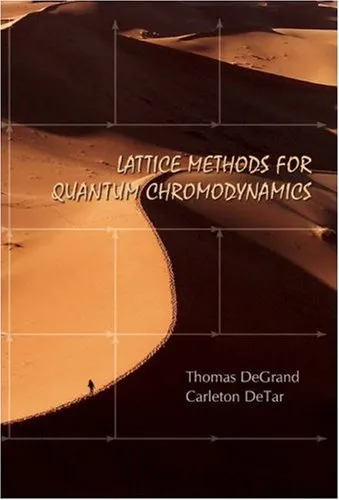
Lattice Methods for Quantum Chromodynamics
Thomas Degrand,Carleton DeTar
English
Beginner
Physics
4.6 / 5
0 reviews
2006
Published
363
pages
165
views
Introduction to "Lattice Methods for Quantum Chromodynamics" "Lattice Methods for Quantum Chromodynamics," authored by Thomas Degrand and Carleton DeTar, serves as a comprehensive guide for understanding the lattice formulation of quantum chromodynamics (QCD). The
Before you read
What will you get from this book?
Introduction to "Lattice Methods for Quantum Chromodynamics"
"Lattice Methods for Quantum Chromodynamics," authored by Thomas Degrand and Carleton DeTar, serves as a comprehensive guide for understanding the lattice formulation of quantum chromodynamics (QCD). The book bridges the gap between theoretical physics and computational methods, presenting lattice QCD as a tool to investigate the strong interactions that govern the behavior of quarks and gluons. By integrating detailed conceptual frameworks with hands-on computational insights, this book has become foundational for both students and researchers in high-energy physics.
Detailed Summary
The book is designed to provide readers with a systematic and accessible introduction to lattice QCD, a numerical approach to solving quantum field theories on spacetime grids known as lattices. Quantum chromodynamics, the core theory of strong interactions, is notoriously difficult to solve analytically due to its non-perturbative nature at low energies. Here, lattice QCD becomes indispensable, enabling numerical simulations that unveil key aspects of particle physics.
"Lattice Methods for Quantum Chromodynamics" begins with the theoretical groundwork essential for understanding QCD, covering the fundamentals of gauge theories and path integral formulations. Using clear mathematical explanations and examples, the authors transition into lattice discretization as a technique to translate continuous equations of QCD into numerically solvable forms. Special attention is given to the formulation of quarks and gluons in the lattice framework.
Later chapters delve into advanced computational techniques, including Monte Carlo simulations, gauge fixing, and methods for extracting physical observables like spectrum, decay constants, and form factors. Critical issues such as finite lattice size effects, temperature dependence in the context of QCD thermodynamics, and renormalization are discussed in depth. Each topic is accompanied by practical guidance on numerical implementations, ensuring readers acquire not only theoretical understanding but also actionable insights.
The structure of the book ensures a logical progression, with each chapter building upon the previous one. From the basics of lattice theory to cutting-edge applications, this text equips readers with the tools to conduct meaningful research or gain a deep appreciation of the computational techniques underpinning modern high-energy physics.
Key Takeaways
- A solid introduction to the fundamental principles of quantum chromodynamics and lattice theory.
- Step-by-step guidance on discretizing quantum field theories for numerical calculations.
- Insight into computational methods such as Monte Carlo simulations and gauge fixing techniques.
- Discussion of physical observables, their extraction, and interpretation within the lattice framework.
- An understanding of critical phenomena like confinement, chiral symmetry breaking, and QCD thermodynamics.
- Practical advice for implementing numerical simulations of quantum field theories.
Famous Quotes from the Book
"The lattice provides a bridge from theory to computation, offering a window into the non-perturbative aspects of particle physics."
"In lattice QCD, understanding the interplay of mathematics, physics, and computation is key to unlocking the hidden symmetries of the universe."
"Monte Carlo methods are more than just numerical tools—they are the backbone of how we navigate the immense complexity of quantum systems."
Why This Book Matters
As an essential text in the field of theoretical physics, "Lattice Methods for Quantum Chromodynamics" provides readers with a roadmap to one of the most challenging yet rewarding areas of modern science. The importance of QCD extends far beyond fundamental physics—it explains phenomena as diverse as the behavior of the quark-gluon plasma in heavy-ion collisions and the intricate structure of hadrons. Without lattice methods, many of these systems would remain poorly understood due to the lack of viable analytic techniques.
Moreover, the book is invaluable not just to quantum field theorists but also to those in computational science. By emphasizing numerical implementation, it bridges high theoretical concepts with practical, real-world applications of computational techniques. Whether you are a graduate student venturing into this field or a seasoned researcher exploring advanced simulation methodologies, this book delivers unparalleled clarity and depth. It equips scientists with the skills to simulate complex systems, interpret results reliably, and push the boundaries of our understanding of the strong force.
In conclusion, "Lattice Methods for Quantum Chromodynamics" is more than just a textbook—it is a gateway for comprehending and exploring the inner workings of the microscopic universe. By demystifying lattice QCD, Degrand and DeTar have empowered a generation of physicists and computational researchers to decode the intricacies of the strong interaction.
Ask this book
Your question is answered in the context of this title and author. Each answer uses 2 points.
Sign in to ask the book assistant.
Reader reviews
0 reviews, 4.6 average out of 5
No reviews yet
If you have read this book, help the next reader with your experience.
Write a review
Sign in to publish a review.
Reader questions and answers
Ask a focused question and learn from the community.
Sign in to ask or answer a question.
No questions yet
Be the first to ask a clear, useful question.
What to read next
Related references that continue this learning path.


Modern Computer Vision with PyTorch: A Practical Roadmap From Deep Learning Fundamentals to Advanced Applications and Generative AI, 2nd Edition
V Kishore Ayyadevara,Yeshwanth Reddy
2023
View book